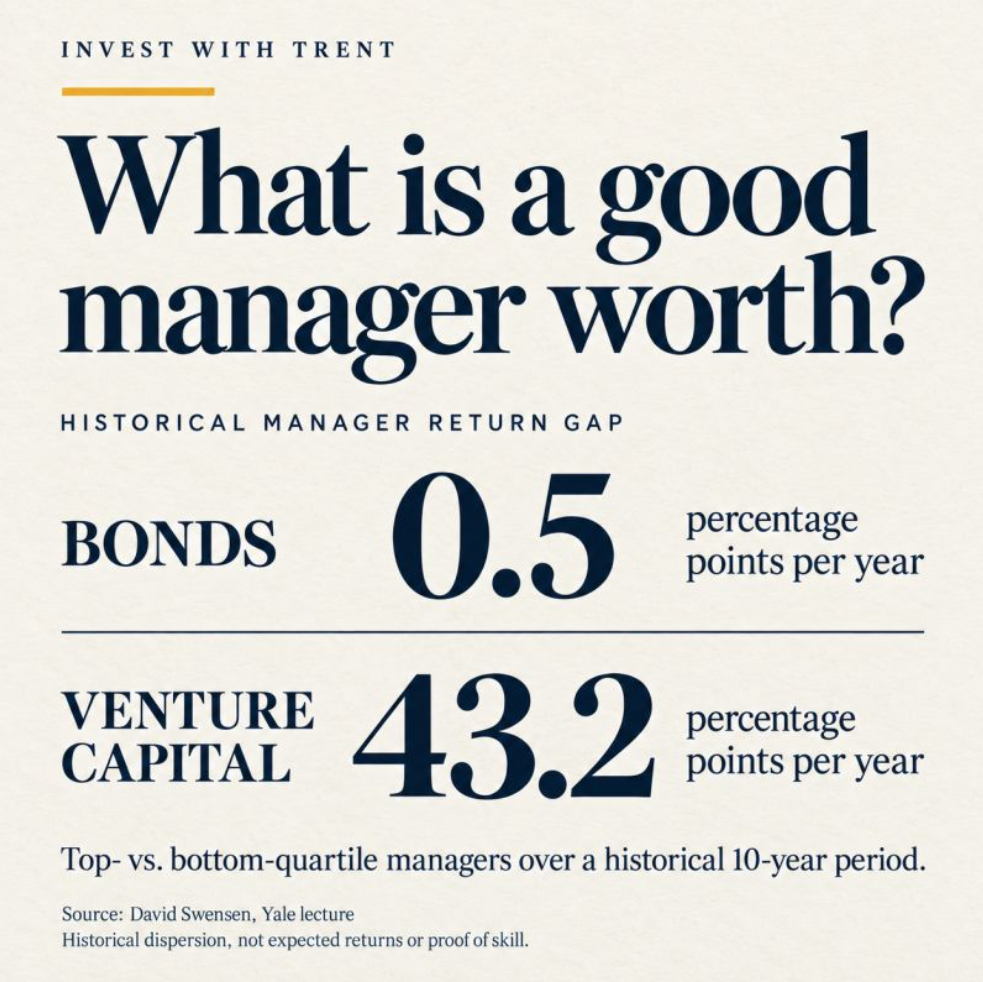
In bonds, the annual return gap was half a percentage point. In venture capital, it was 43.2 percentage points.
That was the difference between top-quartile and bottom-quartile managers in historical 10-year data David Swensen presented at Yale.
The comparison gets more interesting as you move through the asset classes:
Bonds: 0.5 percentage points.
U.S. large-cap stocks: 2.
Foreign stocks: 4.
Real estate: 9.3.
Leveraged buyouts: 13.7.
Venture capital: 43.2.
These are historical gaps between manager results, not returns you could expect to earn today.
Swensen used that spread to help decide where Yale should spend its time evaluating managers. Where results clustered closely together, even a strong manager had relatively little room to distinguish themselves. Where results varied enormously, choosing a manager deserved much more attention.
Think about what that means when you’re deciding how much to pay someone to manage your money.
A fee comes out of your return regardless of how much opportunity the manager has to improve it. If you’re paying for active management in a market where results tend to cluster closely together, the evidence for that fee needs to be compelling.
A wider spread creates a different challenge. The opportunity to choose well comes with the possibility of choosing very poorly.
And the spread itself doesn’t prove skill. Differences in risk, leverage and strategy can also affect results. Identifying past winners is much easier than knowing who will succeed next.
That’s why “private” alone tells you very little about whether an investment deserves your money, or whether its fees are justified.
What I find useful about Swensen’s framework is that it makes the fee conversation specific. What can this manager plausibly add, what risks will they take to do it, and how much of that value will you keep?
Manager selection deserves more effort in some markets than others. The fees you pay should reflect evidence of value, rather than the sophistication of the sales pitch.
Source: David Swensen, Yale lecture, “The Yale Endowment.”