The 10-year Treasury closed at 5.24% yesterday. That’s the highest it’s been since 2007, and it’s changed how I read every investment pitch that comes across my desk.
Here’s what I mean…If the government will pay you 5% to do nothing, anything promising more has to explain where the rest comes from.
When I look at a deal right now, I start with the following questions:
1. Am I locking my money up?
2. Am I further back in line if something breaks?
3. Is there borrowed money underneath that only works if rates cooperate?
I didn’t always think this way. For most of my career I shot first and aimed second, and it worked in business more often than it should have. For example, in 2021, I invested in a deal that promised amazing upside. Shortly after I invested, rates spikes and the deal hasn’t made a dime.
Suffice to say, the the opportunity cost of tying up $100,000 for the last 5 years without a single distribution has been significant.
When I started looking at real estate private credit funds, I took a very different approach. Instead of focusing on the blue sky, I paid a lot more attention to what could go wrong… and how I could protect myself from that.
Prior to making my first investment in a real estate private credit fund, I screened 23 of them. The first thing I asked every one was some version of “walk me through exactly what I’m being paid for.” A lot of them answered with the projected return, which doesn’t answer the question at all.
Seven of them made my short list, and I conducted an extensive amount of due diligence on these funds. I wrote investment memos for each and every one of them, identifying all the red flags that I saw. I then went back and forth with the lead sponsor to try and resolve all of the red flags in my investment memos.
Only one made the cut, so I conducted a site visit, and that’s the fund that I invested in.
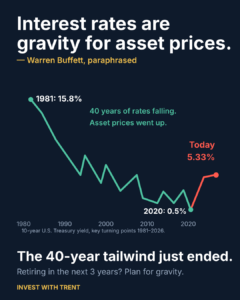
Buffett has compared interest rates to gravity. The higher they go, the harder they pull every asset price down.
Higher rates don’t make every investment worse. In the case of real estate private credit, so long as the leverage is conservative, rising interest rates actually enhance the cash flow, without a significant compromise in safety.
The same can’t be said for rental properties. When interest rates rise, the value of your properties falls immediately, and that may not be the end of the world, but unlike real estate, private credit, you also don’t get an immediate raise. This is because you have to wait until your leases roll over before you can raise rents.
In the fund that I’m invested in, as soon as interest rates start to rise, so does the interest paid by the borrowers on the loans in the portfolio. That gives me immediate protection against inflation, and that helps me to sleep at night.
Now it’s your turn. I’d like to hear what you’re doing to protect your investments in a rising interest rate environment. Thanks for reading!