No—but the confusion is understandable.
Both private real estate credit funds and hard money lenders make real estate loans outside the traditional banking system. Both may close more quickly than a bank, finance transitional properties, and charge higher interest rates than conventional lenders.
That is where the similarity can end.
“Hard money” is a loose industry label, not a standardized investment category. Some hard money lenders operate conservatively. Others make high-leverage, asset-based loans to inexperienced borrowers, distressed property owners, or house flippers who cannot qualify elsewhere.
The name alone tells you very little.
The meaningful questions are who is borrowing, why the bank is not making the loan, how much borrower equity sits beneath the lender, and what claim the lender has against the property if the plan fails.
The Borrower May Be Choosing Private Credit—Not Settling For It
The traditional hard money narrative usually begins with a borrower who has been rejected by every conventional lender.
That is not necessarily how institutional private real estate credit works.
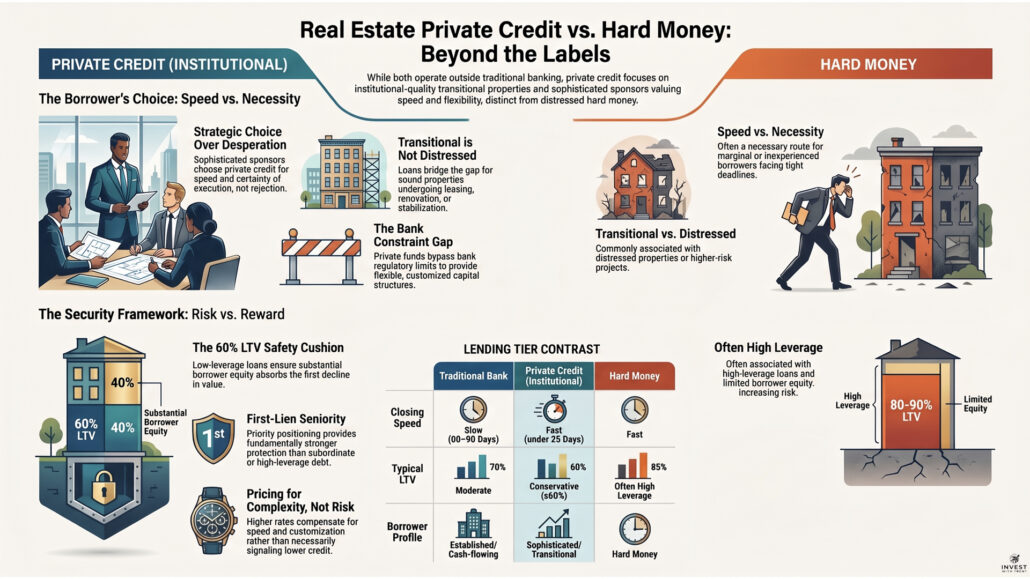
A strong sponsor may have substantial liquidity, an established operating history, and a high-quality property—and still choose a private lender because a bank cannot provide the required speed, structure, or certainty of execution.
⚠️ For a sophisticated real estate operator, the cheapest loan is not always the best loan.
Imagine a sponsor that can acquire a property at a meaningful discount but must close within 25 days. A bank might offer a lower interest rate but require 60 to 90 days for appraisal reviews, committee approvals, documentation, and closing.
If the seller will not wait, the lower bank rate is irrelevant.
The sponsor may willingly pay a higher rate for a 12- to 24-month private loan, execute the business plan, stabilize the property, and refinance with a conventional lender later.
That is not necessarily a marginal borrower. It is a borrower using expensive but flexible capital to solve a specific, temporary problem.
Transitional Does Not Automatically Mean Distressed
Banks generally prefer properties with predictable operating histories and clearly documented cash flow.
Private lenders can finance properties that are fundamentally sound but temporarily fall outside that box.
A recently completed apartment building may still be leasing units. An industrial property may be waiting for a new tenant to begin paying rent. A condominium developer may need financing against completed but unsold inventory. An experienced sponsor may be finishing a renovation that will allow the property to qualify for permanent financing.
These properties are transitional because something is changing—not necessarily because the property or borrower is failing.
The private loan acts as a bridge between the property’s current condition and the point at which it becomes eligible for conventional long-term financing.
Banks Face Constraints That Private Funds Do Not
Banks do not make lending decisions based solely on whether they believe a particular borrower will repay.
They must also manage regulatory capital, liquidity, depositor obligations, commercial real estate concentration limits, internal loan policies, appraisal requirements, and supervisory scrutiny.
Certain acquisition, development, and construction loans may also receive less favorable regulatory-capital treatment when they fall within the definition of high-volatility commercial real estate exposure.
Following the banking stress that began in March 2023, many banks became even more selective about commercial real estate lending. Federal Reserve lending surveys subsequently documented tighter credit standards across commercial real estate loan categories.
This does not mean banks are legally prohibited from making every transitional loan. The more accurate point is that a perfectly reasonable loan may not fit a bank’s current balance-sheet capacity, concentration limits, approval process, or lending policy.
A private credit fund is not funded by demand deposits and does not operate under the same banking framework. It can evaluate each opportunity according to its investment mandate and structure terms around the particular property.
That structural flexibility is part of what the borrower is paying for.
LTV Reveals Who Is Absorbing The First Loss
The clearest distinction is often leverage.
Goodman’s approach focuses on first-lien loans at 60% LTV or less, with the portfolio historically operating at even lower average leverage.
At 60% LTV, a $10 million property supports no more than a $6 million loan. The borrower has approximately $4 million of equity beneath the lender.
That equity absorbs the first decline in value.
By contrast, a lender making a $7.5 million loan against the same $10 million property begins at 75% LTV. After foreclosure costs, unpaid taxes, selling expenses, and deferred maintenance, the lender’s principal could become exposed after a much smaller decline in value.
Some hard money lenders quote loan-to-cost rather than loan-to-value, which can make comparisons even more difficult. Investors should verify what the percentage actually measures rather than relying on the headline number.
The important distinction is not the terminology. It is the amount of verified collateral value protecting each dollar of principal.
Lien Position Matters Just As Much As Leverage
A loan described as “real estate-backed” can still occupy a vulnerable position.
A first-lien mortgage generally has priority over the borrower’s equity and subordinate financing. A mezzanine loan, second mortgage, or preferred-equity investment may sit behind a substantial senior loan and begin absorbing losses much sooner.
Goodman’s strategy emphasizes first-lien loans.
That does not make principal immune from loss. Property values can fall, appraisals can be wrong, and enforcement can be expensive. But a conservative first-lien position provides a fundamentally different level of protection from a high-leverage or subordinate investment.
Higher Pricing Does Not Automatically Mean Lower Credit Quality
Private borrowers commonly pay more because they are purchasing capabilities a bank may not offer:
- A faster and more reliable closing
- A loan tailored to an unusual business plan
- Future funding tied to construction or leasing milestones
- Financing for completed condominium inventory
- Greater flexibility around prepayment or extension
- Certainty that committed capital will remain available
The additional interest compensates the lender for speed, complexity, illiquidity, and customized structuring.
Sometimes a high rate does signal elevated borrower risk. But it should not be assumed automatically.
The investor’s job is to determine whether the extra yield comes from solving a structural problem for a qualified borrower—or from accepting credit risk that a prudent lender should avoid.
The Label Is Less Important Than The Loan Tape
Two managers can both describe themselves as private real estate lenders while running almost opposite strategies.
One may finance experienced sponsors at 50% to 60% LTV using first mortgages on diversified commercial properties.
Another may make 75% LTV loans to house flippers in one geographic market, depend on continued price appreciation, and concentrate a large percentage of the fund with a few borrowers.
Calling both “private credit” does not make their risks comparable.
The same is true of the term “hard money.” The label should never replace due diligence.
Investors should examine the actual loan tape, including average and maximum LTV, lien position, borrower experience, property type, geographic concentration, loan duration, repayment source, and historical workout results.
The real distinction is not bank lending versus private lending—or even private credit versus hard money.
It is conservative credit versus aggressive credit.
One begins by asking how much can be earned if everything works.
The other begins by asking how much can go wrong before investor principal is impaired.