What if you could move a $500,000 investment from a traditional IRA into a Roth IRA—but potentially pay conversion tax on only $300,000?
Then imagine that investment growing to more than $3.3 million over the next 20 years.
Inside the traditional IRA, withdrawals would generally be taxable.
Inside the Roth, qualified withdrawals could be completely tax-free.
At a 30% future tax rate, that difference could amount to more than $1 million.
It sounds too good to be true.
But under the right circumstances, it may be possible through a strategy called a discounted Roth conversion.
Here is how it works, what makes the discount possible, and what investors need to understand before considering it.
First, What Is a Roth Conversion?
Money in a traditional IRA has usually not been taxed yet.
When you withdraw it, the distribution is generally taxed as ordinary income.
A Roth conversion allows you to move that money into a Roth IRA. You pay tax when you convert it, but future growth and qualified withdrawals can then be tax-free.
A normal conversion is simple.
If you convert $100,000, you may have to report $100,000 of taxable income.
A discounted Roth conversion is different.
It may allow you to convert an investment originally purchased for $100,000 while reporting a lower amount, such as $60,000, as taxable income.
The key is the investment’s current fair market value.
Where Does the Discount Come From?
Suppose your traditional IRA owns an interest in a private real estate debt fund.
Unlike a publicly traded stock, that fund interest may be difficult to sell.
You may face several restrictions:
- There may be no public market for the investment.
- You may have to hold it for a minimum amount of time.
- The fund may control when you can request your money back.
- You may not be allowed to sell your interest without approval.
- As a small investor, you have little control over the fund.
These restrictions can make the investment less valuable to a buyer today.
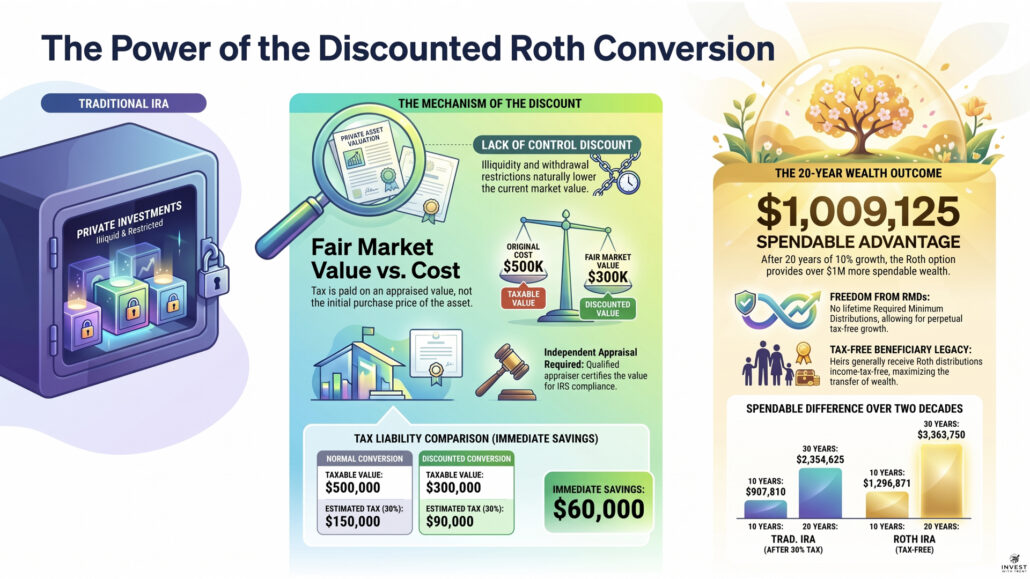
An independent appraiser studies those restrictions and determines what the investment is currently worth. This is called its fair market value.
The IRS generally uses the property’s fair market value when an investment is converted from a traditional IRA to a Roth IRA. IRS guidance explains this rule here.
A $500,000 Example
Suppose your traditional IRA invests $500,000 in a private real estate debt fund.
An independent appraiser reviews the fund documents, withdrawal restrictions, lack of a public market, and your lack of control.
The appraiser concludes that the fund interest has a current fair market value of $300,000.
You then convert the investment to a Roth IRA.
If the valuation is properly supported and accepted, you may have to report $300,000 of conversion income rather than $500,000.
Assuming a combined 30% federal and state tax rate:
| Normal Conversion | Discounted Conversion | |
| Amount invested | $500,000 | $500,000 |
| Taxable conversion value | $500,000 | $300,000 |
| Estimated tax at 30% | $150,000 | $90,000 |
| Estimated tax reduction | $60,000 |
This does not mean $200,000 disappeared.
It does not mean the fund lost $200,000.
It means an independent appraiser determined that a buyer would pay less for the investment because of the restrictions attached to it.
Why Would Anyone Pay Less for the Same Investment?
Imagine two identical houses.
You can sell the first house whenever you want.
You cannot sell the second house for several years, and you need someone else’s permission before accepting an offer.
Most buyers would pay less for the second house.
The house may produce the same rent. It may have the same future potential. But the restrictions make it less useful to the buyer today.
The same principle can apply to an interest in a private fund.
Appraisers often describe these restrictions using two terms:
- Lack of marketability: The investment may be difficult to sell.
- Lack of control: A small investor cannot control the fund’s important decisions.
These factors may support a lower valuation. However, there is no automatic discount.
An appraiser could determine that the discount should be small, large, or nonexistent.
The Goodman Capital materials accompanying this article describe potential discounts of approximately 40% to 50%. They also provide an example in which an LCSF II interest reportedly received a discount of more than 43%.
Those are examples—not promises.
Every valuation depends on the investment, its governing documents, current market conditions, and the appraiser’s professional judgment.
What Happens After the Conversion?
The investment moves into the Roth IRA, but the investment itself does not change.
The same lockup and withdrawal restrictions still apply. The same investment risks still exist.
What changes is the account that owns it.
Future income and growth may now accumulate inside the Roth without annual income tax. Qualified withdrawals can also be tax-free.
This is where the long-term benefit can become much larger than the initial tax savings.
The Potential Difference After 10 And 20 Years
Suppose two investors each begin with $500,000.
One leaves the money in a traditional IRA.
The other converts the investment to a Roth IRA and pays the conversion tax using money outside the retirement account.
Both investments earn 10% per year.
After 10 years, each account would contain approximately $1,296,871.
After 20 years, each would contain approximately $3,363,750.
The balances are identical because the investments earned the same return.
The difference appears when the money is withdrawn.
Assume the investor pays a combined 30% tax rate on withdrawals from the traditional IRA. Also assume the Roth withdrawals meet all requirements to be tax-free.
| After | Traditional IRA Balance | Spendable After 30% Tax | Spendable From Roth | Difference |
| 10 years | $1,296,871 | $907,810 | $1,296,871 | $389,061 |
| 20 years | $3,363,750 | $2,354,625 | $3,363,750 | $1,009,125 |
After 10 years, the Roth could provide approximately $389,061 more in spendable money.
After 20 years, the difference could exceed $1 million.
The Roth did not earn a higher return. Both accounts earned exactly 10%.
The difference is taxes.
The Roth’s taxes were paid near the beginning. The traditional IRA’s taxes were delayed until after the account had grown substantially.
These figures are illustrations, not predictions. They also do not subtract the conversion tax or the return that money might have earned elsewhere.
A complete analysis must include those costs.
What About Required Minimum Distributions?
Traditional IRA owners must generally begin taking required minimum distributions, or RMDs, after reaching the applicable age.
Those withdrawals can create taxable income even when the investor does not need the money.
Roth IRA owners do not have RMDs during their lifetimes.
That allows the money to remain invested for as long as the owner chooses. It can also make a Roth useful for leaving assets to beneficiaries.
What Happens When Beneficiaries Inherit the Roth?
Most non-spouse beneficiaries must empty an inherited Roth IRA by the end of the tenth year following the owner’s death.
They may not have to withdraw the entire balance immediately. Depending on the rules that apply, the money may remain invested inside the Roth for some or all of that period.
Qualified withdrawals are generally income-tax-free.
The Roth’s five-year rule still matters. The clock generally begins on January 1 of the first year the original owner funded any Roth IRA.
Special rules can apply to spouses, minor children, disabled or chronically ill beneficiaries, and certain other beneficiaries. The IRS explains these rules in Publication 590-B.
Estate taxes and state taxes may also apply in some cases, so an inherited Roth should not always be described as completely tax-free.
What Are the Risks?
A discounted Roth conversion is not free money.
There are several important risks:
- The valuation could be challenged. The IRS may question a discount that is aggressive or poorly supported.
- The tax is due now. A conversion creates taxable income in the year it occurs.
- The conversion could raise your tax bracket. It may also affect Medicare premiums and other tax calculations.
- The investment remains illiquid. The valuation discount often exists because the investment is difficult to sell.
- The investment can lose money. Moving it into a Roth does not protect it from defaults, falling real estate values, or poor performance.
- The Roth rules are complicated. Different five-year rules can apply to tax-free earnings and early withdrawals of converted money.
Investors should generally pay the conversion tax using money outside the IRA when possible. Taking money from the IRA to pay the tax leaves less capital in the Roth and may create additional taxes or penalties.
How Does the Process Work?
The process usually involves six steps:
- A self-directed traditional IRA invests in an eligible private fund.
- A qualified independent appraiser determines the interest’s fair market value.
- The appraisal is submitted to the IRA custodian.
- The custodian transfers the fund interest into a Roth IRA.
- The custodian reports the conversion on the required tax forms.
- The investor reports the conversion and pays the related tax.
Not every custodian will accept the same appraisal or handle the transaction in the same way.
Confirm the requirements with the custodian, CPA, and attorney before investing or ordering an appraisal.
The Bottom Line
A discounted Roth conversion does not make taxes disappear.
It may allow an investor to pay tax on a private investment’s properly appraised fair market value rather than the amount originally invested.
That can reduce the cost of moving the investment into a Roth.
Once inside the Roth, future growth and qualified withdrawals may be tax-free. Over 10 or 20 years, that benefit could become far more valuable than the initial valuation discount.
But the discount must be real.
It should be calculated by a qualified independent appraiser, supported by the investment’s actual restrictions, accepted by the custodian, and reviewed by experienced tax and legal professionals.
The goal is not to claim the largest discount possible.
The goal is to use a fair value that you can clearly explain—and confidently defend.
This article is for educational purposes only. It is not tax, legal, accounting, or investment advice. Valuation discounts, investment returns, and tax results are not guaranteed. Consult qualified professionals regarding your individual circumstances.