The short answer is that the direct correlation should be relatively low—but “low correlation” should not be confused with “no economic risk.”
A stock market decline and a recession are also not the same thing.
Stocks can fall because valuations were too high, interest-rate expectations changed, or investors became more risk-averse. None of those events automatically prevents a real estate borrower from making a scheduled loan payment.
A recession is different. It can reduce rents, slow property sales, restrict refinancing, and weaken a borrower’s ability to repay. That creates a more meaningful connection between the economy and the performance of a real estate loan portfolio.
The important distinction is that private real estate credit is not dependent on rising asset values to generate its return.
The Return Comes From Contracts, Not Market Appreciation
An equity investor generally needs some combination of rental income, operating improvement, and property appreciation to earn the expected return.
A lender’s return is structured differently.
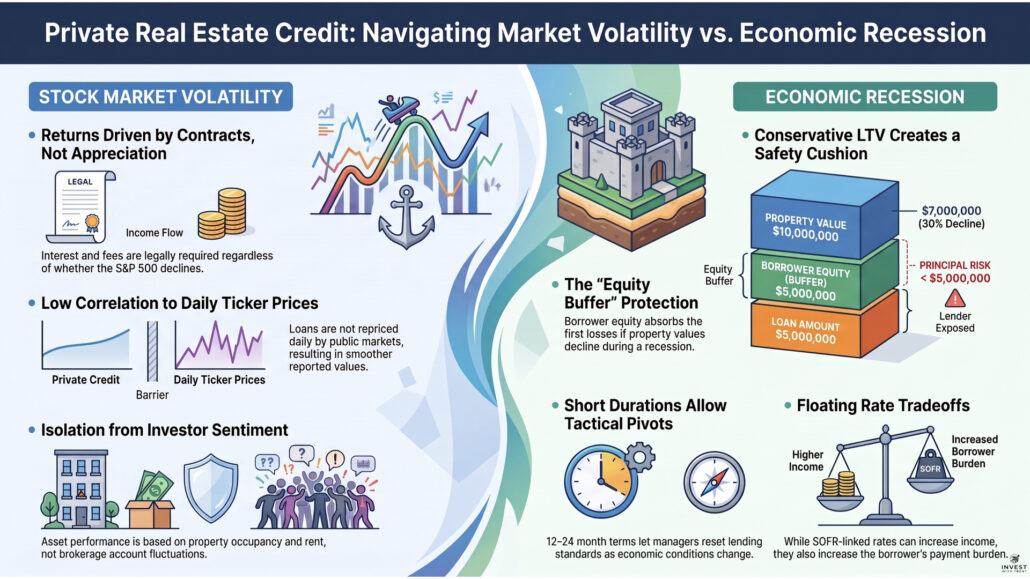
The borrower signs a contract requiring the payment of interest and fees. As long as the borrower continues performing, those payments do not change simply because the S&P 500 declines by 20%.
The loan is not repriced every second by buyers and sellers in a public market. Its economics are established in the loan documents.
This creates much less direct exposure to stock prices, earnings multiples, investor sentiment, and daily market volatility.
However, contractual income is only as reliable as the borrower’s ability to honor the contract. If a recession damages the property’s cash flow or eliminates the borrower’s planned exit, the loan can still become distressed.
A Stock Market Correction May Have Little Direct Effect
Imagine that technology stocks fall sharply because investors decide they are no longer willing to pay 30 times earnings.
That decline may reduce an investor’s brokerage-account balance immediately.
But it does not necessarily change the occupancy, rent collections, or value of a well-located apartment building, industrial property, or other real estate collateral. Nor does it automatically change the amount a borrower owes under a first-mortgage loan.
In that scenario, the stock market and the loan portfolio may behave very differently.
This is one reason private real estate credit can provide useful diversification inside a portfolio dominated by publicly traded stocks and bonds.
But there is an important caveat: private loans are not priced continuously.
A public stock can decline 15% in one afternoon. A private real estate loan may continue to be carried near its original value until new information requires the manager to recognize an impairment.
That smoother reported value does not necessarily mean the underlying investment is completely unaffected. Some of the apparent stability comes from the absence of daily market pricing.
A Recession Creates More Meaningful Risks
A recession can affect the actual economics supporting a loan.
Tenants may close businesses or stop paying rent. Apartment vacancies may rise. Hotel occupancy may decline. Homebuilders may take longer to sell inventory. Banks may tighten lending standards, making it harder for borrowers to refinance maturing loans.
Those pressures can produce several consequences:
- Interest payments may arrive late.
- Loans may need to be extended or modified.
- Fund distributions may decline or become less predictable.
- Foreclosure and bankruptcy proceedings may take longer.
- Collateral may ultimately sell for less than originally expected.
Therefore, it would be inaccurate to describe private real estate credit as recession-proof.
The more accurate statement is that a conservatively structured first-lien loan can withstand a meaningful amount of economic stress before that stress becomes a loss of investor principal.
Conservative Leverage Creates the Buffer
Suppose a lender makes a $5 million loan against a property worth $10 million.
The borrower’s $5 million of equity sits beneath the lender and absorbs the first decline in value. The property could fall substantially before the lender’s principal became exposed.
A lender starting at 75% LTV has a much smaller cushion. After selling costs, unpaid taxes, legal expenses, and deferred maintenance, even a moderate decline in the property’s value could threaten principal.
This is why correlation cannot be evaluated separately from underwriting.
Two funds may both call themselves private real estate credit funds while holding dramatically different risks. One may own conservatively leveraged first mortgages. Another may make high-LTV bridge loans, subordinate loans, or hard-money loans to house flippers.
Their performance during a recession may look nothing alike.
Short Loan Durations Provide Flexibility
Most loans in this strategy have initial terms of approximately 12 to 24 months.
That does not guarantee every loan will repay within 24 months. A borrower may request an extension, and a distressed loan can take considerably longer to resolve.
The advantage is that the portfolio is not deliberately locking in today’s underwriting assumptions for the next seven or ten years.
As performing loans repay, the manager can evaluate current conditions before redeploying the capital.
If property values are declining, new loans can be made at lower LTVs. If refinancing has become more difficult, the manager can require additional reserves or a more credible exit plan. If an entire property sector appears vulnerable, the manager can reduce or stop new originations in that sector.
An equity fund holding properties for seven to ten years generally has less ability to reposition one investment at a time.
Floating Rates Can Help—But They Create a Tradeoff
Floating-rate loans can provide another layer of protection when interest rates rise. Because loan coupons reset with a benchmark such as SOFR, interest income may increase without requiring the lender to wait for an existing loan to mature.
If a recession causes the Federal Reserve to reduce interest rates, however, floating-rate income may decline. Interest-rate floors can limit that decline, but the details depend on the individual loan documents.
There is also a borrower-level tradeoff. Higher rates may increase the lender’s interest income, but they also increase the borrower’s payment burden. That makes conservative leverage and careful debt-service underwriting even more important.
The Goal Is Different Economic Exposure, Not Immunity
Private real estate credit can behave differently from public stocks because its return comes primarily from contractual interest and fee income rather than expanding valuations or property appreciation.
That makes it potentially valuable as a diversifier.
But diversification is not immunity. In a severe recession, correlations across many assets can rise as property values fall, liquidity disappears, and borrowers struggle simultaneously.
The real protection comes from the combination of first-lien position, conservative LTVs, short loan durations, strong documentation, active servicing, and disciplined manager behavior.
The right conclusion is not, “This investment cannot be hurt by a recession.”
It is, “This investment is structured so that a stock market decline does not automatically reduce its income