If you’d asked almost any investor in 1989 to name the strongest economy in the world, plenty would have said Japan without hesitating, and they’d have had good reasons.
Japanese manufacturing was beating everyone, Japanese companies were buying trophy real estate in New York, and serious books were being written about how American business needed to reorganize itself around Japanese management practices.
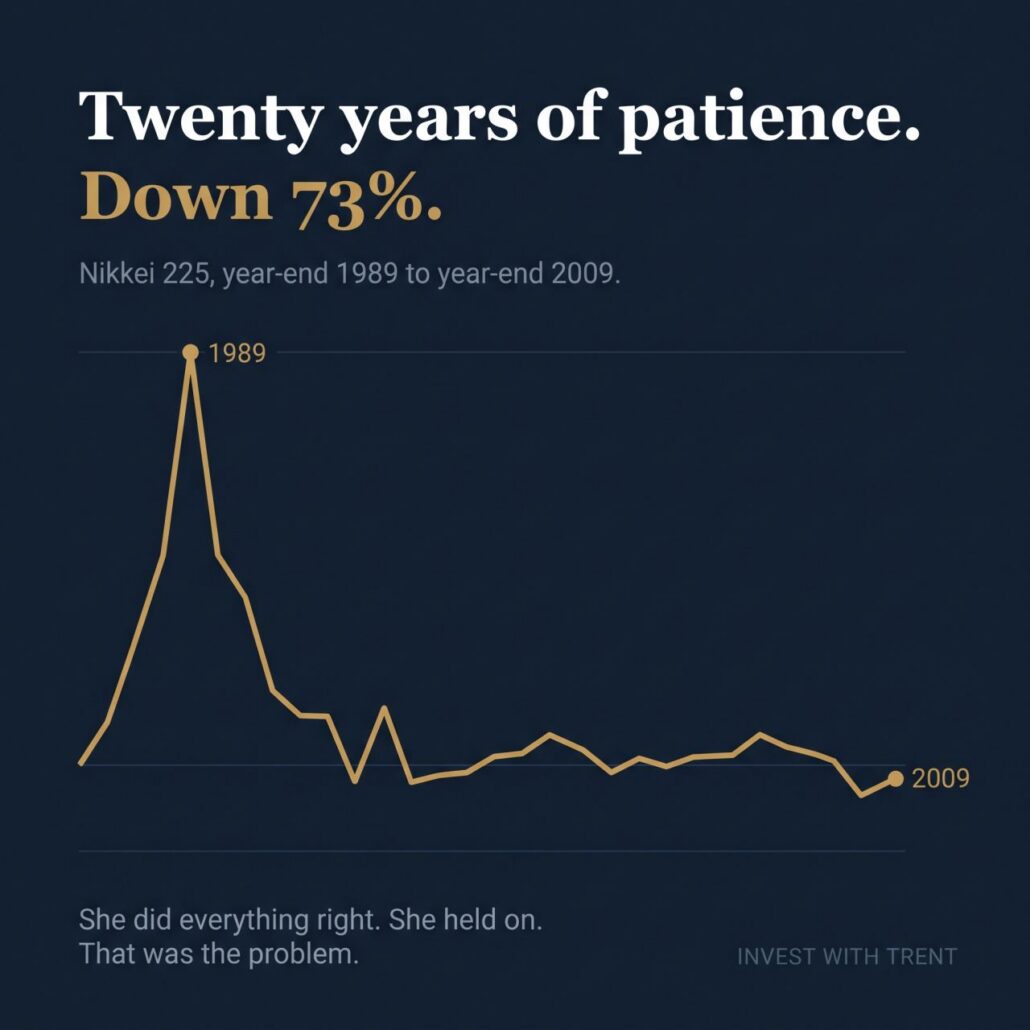
At the end of 1989 the Nikkei closed at just under 39,000.
Now picture a Japanese investor at that moment doing everything we tell people to do. Long time horizon, disciplined, not trying to time anything, with a healthy bias toward equities because over long stretches equities have historically beaten everything else. She’s invested primarily at home, which felt sensible, because that’s the economy she understood and it was the one winning.
Twenty years later, at the end of 2009, the Nikkei closed around 10,500.
That’s a decline of roughly 73% over two full decades, for someone who did nothing wrong by any of the usual definitions. She didn’t panic sell or chase a hot fund. She held on the whole way, exactly like the books say to, and holding on is what cost her.
I bring this up because “just stay the course” gets treated as though it’s a complete strategy, and it isn’t.
Staying the course is just one component of a strategy, and it only works if the thing you’re staying the course in is genuinely diversified. A long time horizon is necessary. It is nowhere close to sufficient.
The surprising part is that her portfolio didn’t look reckless. It looked prudent. Broad domestic equity exposure in the world’s most admired economy isn’t a crazy thing to own in 1989.
The concentration was invisible right up until it wasn’t, and by then twenty years had gone by.
I’m not predicting anything here. I have no idea what the U.S. market does over the next twenty years and neither does anybody else.
But “it couldn’t happen here” is exactly what someone in Tokyo would have told you in 1989, and they had better evidence for it than most people have for anything they believe about markets today.
So the question I’d sit with isn’t whether the U.S. is Japan, because that’s unknowable and arguing about it wastes an afternoon. It’s narrower: if my long horizon is doing the heavy lifting in my plan, what exactly am I holding on to, and does all of it get paid by the same economy, the same currency, and the same interest rates?
Most people have never actually answered that. It’s worth an evening.
On September 17th at 3:00 PM Eastern, I am holding a webinar to talk about how six things most people with a seven-figure retirement account have never been told. Comment WEBINAR and I will DM you a link to the registration page, where you can learn more about the content of the webinar and register if you are so inclined.