Every conversation I have with someone over fifty who’s built real money lands on the same question, always asked the same way. Halfway through dinner, or at the end of a call, in that casual tone people use when they’re hoping the answer is no.
“Do you think the market’s too high?”
I’ve stopped answering it, and it isn’t me being cagey. I’ve just watched what happens to people who act on whatever answer they get.
Morningstar once compared what mutual funds returned against what investors in those funds actually earned, across seventeen categories of U.S. equity funds over a decade. In all seventeen, investors earned less than the fund did. Not most. Every single one.
The reason is boring. Money shows up after good performance and leaves after bad, and everybody knows in the abstract this is a mistake. The trouble is that the moment selling feels obvious to you is the same moment it feels obvious to everyone else.
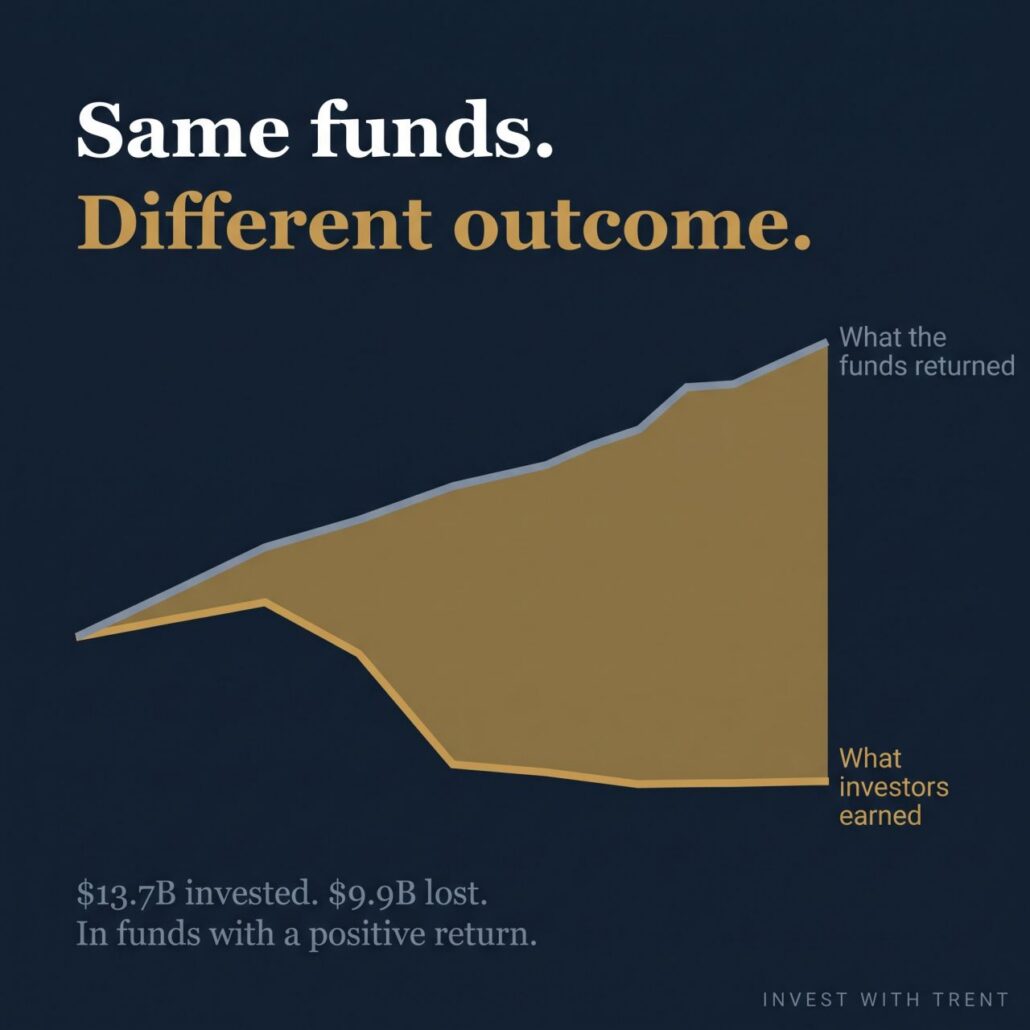
The clearest example is the internet funds around the dot-com era. Across the three years before the bubble and the three after, the top ten returned roughly positive 1.5% a year. Unremarkable, but nobody got hurt.
Except that isn’t what happened to actual people. Investors put 13.7 billion dollars into those funds and lost 9.9 billion of it. Seventy-two cents on the dollar, in funds whose published return was positive.
That’s because almost nobody owned them in 1997. The money arrived in late 1999 and early 2000, right at the top, after the story got good enough that it was hard to sit out, and left in 2001 and 2002 once the story broke. The funds did fine on paper. The people in them got destroyed.
And this isn’t just a retail problem. After the 1987 crash, university endowments, with professional staff and every advantage you can name, took roughly six years to rebuild their equity allocations. They sat underweight through the start of one of the great bull markets in history.
So here’s what I think about that dinner table question now. It feels like diligence, but it’s really the setup for the most expensive thing an individual investor can do, which is make one big timing decision under pressure using a fact everybody already knows.
There’s a better question, and you can actually answer this one. Not “is the market too high,” but “what do I own, and does all of it get paid by the same thing?”
That one has a real answer, sitting in your statement right now. It requires no prediction, and nobody can be more right about it than you are, because it’s your portfolio. Most people I ask have never worked it out. They know the balance to the dollar and have never spent ten minutes on what’s underneath it.
On September 17th at 3:00 PM Eastern, I am holding a webinar to talk about how six things most people with a seven-figure retirement account have never been told. Comment WEBINAR and I will DM you a link to the registration page, where you can learn more about the content of the webinar and register if you are so inclined.