At first glance, it sounds suspicious.
If a borrower is wealthy, why would they accept a 10%, 12%, or even higher interest rate when a bank might lend at 7%?
Because sophisticated borrowers do not always choose the cheapest capital.
They choose the capital that gives them the best overall outcome.
Here are the most common reasons.
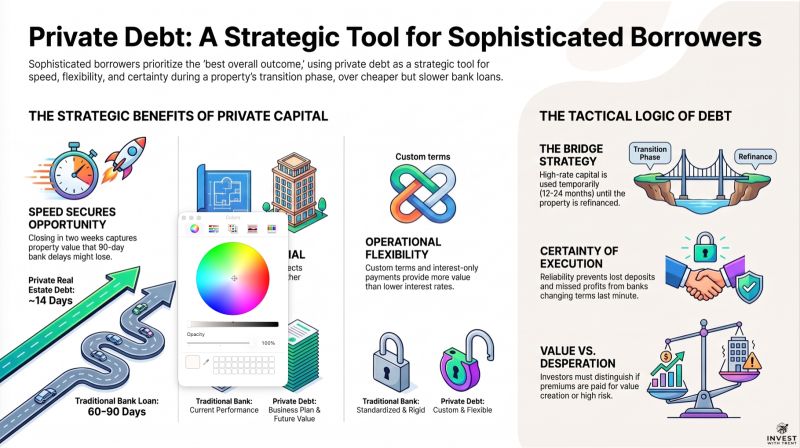
1. Speed matters more than the interest rate
A bank loan may take 60–90 days to close. A private lender may close in two weeks.
Suppose an investor can buy a property for $8 million that is worth $10 million—but only if they close quickly.
Paying an extra $150,000 in interest may be rational if it allows them to capture $2 million in value.
The expensive loan is not the opportunity. It is the tool that secures the opportunity.
2. Banks lend on what exists today
Private lenders are often willing to lend based on what the property can become.
A vacant building, unfinished development, major renovation or lease-up project may not produce enough current income to satisfy a bank’s underwriting rules.
A wealthy borrower may have a strong balance sheet and a sound business plan, but the property itself does not yet qualify for conventional financing.
3. The borrower needs flexibility
Banks tend to offer standardized loans with rigid requirements.
Private lenders may offer:
– Interest-only payments
– Custom draw schedules
– Flexible prepayment terms
– Loans against unusual properties
– Capital for renovations or stabilization
– Faster approval of changes during the project
That flexibility can be worth far more than a lower stated rate.
4. The loan is temporary
Many private real estate loans are bridge loans, not permanent financing.
The borrower may plan to buy the property, improve it, increase occupancy, stabilize the income and then refinance with a bank.
They are not planning to pay 12% for ten years. They may only need the money for 12–24 months.
5. Certainty has value
A bank can spend months reviewing a loan and still change its terms—or decline it—shortly before closing.
A private lender that understands the asset and can reliably fund on schedule may be the safer choice, even at a higher price.
Missing a closing can mean losing the deposit, the property and the future profit.
But here is the important distinction:
A high interest rate does not automatically mean the borrower is desperate.
Sometimes it means the borrower is buying speed, flexibility and certainty.
Other times, it means no bank was willing to accept the risk.
That is why a debt-fund investor should ask:
Is the borrower paying a premium because the capital creates value—or because this is the only capital they can find?
Those two loans may carry the same interest rate…but not the same risk.
To learn more about investing in real estate credit, follow me here.