At first glance, private real estate lending does not make sense.
If a bank is willing to lend at 7%, why would an experienced real estate operator voluntarily borrow at 9% or 10%?
The short answer is that sophisticated borrowers are rarely comparing interest rates alone. They are comparing the total cost—and probability—of successfully completing a transaction.
In many cases, the cheapest loan is not the loan with the lowest interest rate. It is the loan that closes on time, provides the right structure, and allows the borrower to execute a profitable business plan.
Banks Are Designed for Stability, Not Flexibility
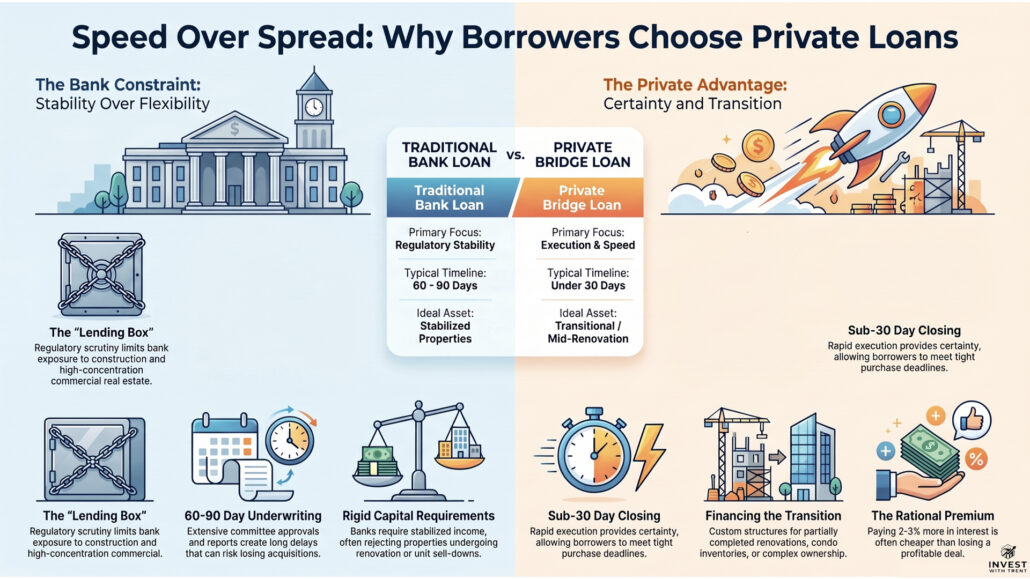
Banks perform an essential role in the financial system, but they operate within legislative, regulatory, and internal risk-management constraints.
Those constraints became particularly visible following the March 2023 banking crisis. Regulators increased their scrutiny of liquidity, interest-rate exposure, commercial real estate concentrations, and construction lending. Banks responded by becoming more selective about the loans they would make and the terms they would offer.
The Federal Reserve’s lending surveys subsequently documented tighter commercial real estate standards, including lower loan-to-value ratios, higher debt-service-coverage requirements, smaller maximum loan amounts, and shorter interest-only periods. Although some standards have since eased, commercial real estate credit has remained relatively tight by historical measures.
Federal banking guidance also calls for heightened risk management when construction and development lending or total commercial real estate exposure becomes large relative to a bank’s capital. These are not necessarily absolute prohibitions, but they can make a perfectly reasonable loan difficult for a particular bank to approve.
The result is an important distinction:
A borrower can be creditworthy, and the property can be valuable, while the loan still falls outside a bank’s current lending box.
Private Lenders Finance the Transition
Private lenders typically serve borrowers whose properties are in transition.
Consider a developer who has completed a condominium project but still has 15 units to sell. The remaining inventory may be worth considerably more than the requested loan, but a conventional bank may be uncomfortable with the repayment schedule, concentration risk, or declining collateral balance as individual units are sold.
A private lender can structure a condo-inventory loan with release prices for each unit and use the sales proceeds to reduce the outstanding balance.
Or consider an apartment renovation that is 80% complete. The property may not yet produce enough income to satisfy a bank’s debt-service requirements, even though most of the work is finished and the remaining construction budget is clearly defined.
A private lender may provide a construction-completion loan based on the property’s current value, remaining costs, borrower equity, and projected value after completion.
Other situations may require a non-revolving line of credit, an acquisition loan with renovation funding, a bridge loan while a property is being leased, or financing that can accommodate an unusually complex ownership structure.
These loans are not necessarily “bad loans” rejected by every bank. Often, they are simply loans that require more customization than conventional banking systems are designed to provide.
Certainty and Speed Have Economic Value
Imagine that a borrower has the opportunity to acquire a property for $10 million, but only if the transaction closes within 25 days.
A bank may offer a lower rate while requiring 60 to 90 days for underwriting, appraisal review, environmental reports, committee approval, and documentation. It may also reserve the right to change the loan amount—or decline the transaction entirely—late in the process.
A private lender capable of closing in fewer than 30 days gives the borrower something valuable: certainty of execution.
If missing the deadline means losing a profitable acquisition, forfeiting a deposit, or allowing a partially completed project to sit idle, paying an additional 2% to 3% in annual interest may be a rational business decision.
The key is the intended holding period.
Suppose a borrower pays a 2.5% annual premium on a $5 million loan held for 18 months. The additional interest cost is approximately $187,500. That is significant, but it may be small relative to the profit protected by closing the acquisition, completing construction, leasing the property, or avoiding a distressed sale.
The borrower is not planning to use expensive private capital forever. The private loan is a bridge.
Once the property is stabilized, completed, or sufficiently sold down, the borrower can refinance with a bank, sell the asset, or repay the loan from operating proceeds.
The Higher Rate Is Not Free Money for Investors
Investors should not interpret the rate premium as evidence that private lending produces higher returns without additional risk.
Transitional properties carry execution risk. Construction can run over budget. Condo sales can slow. Lease-up can take longer than projected. Refinancing markets can change before the loan matures.
That is why disciplined underwriting matters.
The private lender must evaluate the borrower’s experience, the property’s current value, the remaining capital required, the proposed exit strategy, and the margin of safety if the original plan takes longer than expected. Loan structure, collateral position, reserves, guarantees, and conservative leverage may be more important than the stated interest rate.
The most attractive private loans are not necessarily those carrying the highest coupons. They are loans in which the borrower has a credible short-term need, meaningful equity at risk, and a realistic path to repayment.
Private borrowers pay more because they are purchasing something conventional banks often cannot provide: speed, certainty, and a financing structure designed around the actual transaction.
For the right borrower, that flexibility can be worth considerably more than the additional interest.