
If one real estate credit fund expects to earn investors 11–12%, while another advertises 15% or more, the higher-returning fund can appear to be the better investment.
But that conclusion may change once you look at what the fund is actually financing.
A first-position mortgage at 75% loan-to-value on a house being flipped is not economically comparable to a more conservatively leveraged loan on an institutional-quality commercial property.
Both investments may be described as “senior real estate debt.”
They do not have the same margin of safety.
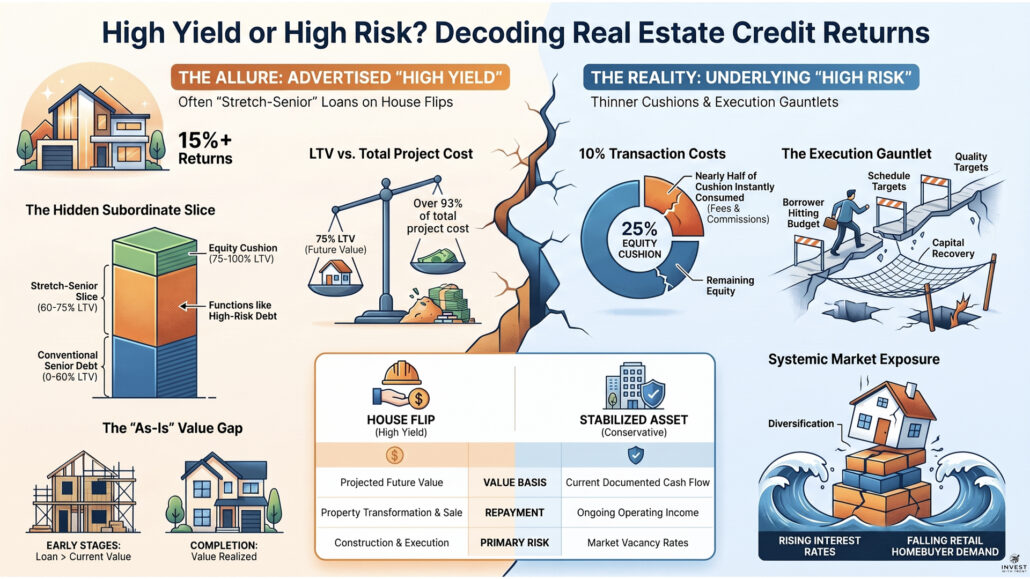
A 75% LTV Loan Contains a Riskier Slice
Consider a house with an estimated value of $500,000 after renovations are completed.
A hard-money lender provides a loan equal to 75% of that projected value, or $375,000.
The lender is legally in first position. But economically, the loan contains several layers of risk.
The first $300,000 represents exposure from 0% to 60% of the property’s value. The remaining $75,000 represents exposure from 60% to 75%.
That final $75,000 occupies the loss range that a separate junior lender would otherwise occupy.
In other words, a 75% LTV stretch-senior loan can be thought of as:
- A senior loan from 0% to 60% LTV
- A higher-risk subordinate slice from 60% to 75% LTV
It may be documented as one first mortgage, but the last dollars advanced are still the first lender dollars exposed after the borrower’s equity is exhausted.
That additional risk is one reason the borrower pays a higher interest rate and more fees.
Seventy-Five Percent of Which Value?
The stated LTV is only meaningful if investors understand the denominator.
Is the loan 75% of:
- The property’s current as-is value?
- The purchase price?
- The total project cost?
- The appraised after-repair value?
- The sponsor’s projected future sale price?
These numbers can be dramatically different.
Suppose a flipper purchases a house for $300,000 and expects to spend $100,000 renovating it. The projected after-repair value is $500,000.
A loan equal to 75% of after-repair value would be $375,000.
That may sound like the lender has a 25% equity cushion. But before the renovation is completed, the property may be worth only $300,000. The additional value does not yet exist. It must be created through construction, cost control, project management, and a successful retail sale.
Even after including the planned renovation budget, the total project cost is $400,000. The borrower has only $25,000 of cash beneath a $375,000 loan—before financing costs, selling expenses, or cost overruns.
Measured against total project cost, the loan represents 93.75%.
The advertised 75% LTV and the actual dollars at risk tell very different stories.
A Flip Loan Has Multiple Things That Must Go Right
A stabilized apartment building may already have tenants, documented operating income, and an established value based on current cash flow.
A house flip usually depends on a future transformation.
The borrower must:
- Complete the renovation
- Stay within budget
- Finish on schedule
- Avoid contractor and permitting problems
- Produce the expected quality
- Find a retail buyer
- Obtain the anticipated sale price
- Sell before interest and carrying costs consume the profit
If any part of that plan fails, the lender may be forced to take control of an incomplete project.
An unfinished house is not simply a completed house worth slightly less. It may require additional construction capital, contractor management, security, insurance, property taxes, utilities, and months of holding costs before it can be sold.
The lender’s recovery therefore depends not only on the property but also on the accuracy of the renovation budget, the borrower’s execution, and the validity of the projected after-repair value.
Transaction Costs Consume the Cushion
A property does not have to decline all the way to the loan balance for a lender to lose money.
Return to the $500,000 house with a $375,000 loan.
If the completed property can only be sold for $420,000, it still appears to cover the loan by $45,000.
But the lender may incur brokerage commissions, legal fees, property taxes, insurance, unpaid interest, repairs, closing costs, and foreclosure expenses. If those costs total 10% of the sale price, net proceeds fall to approximately $378,000.
Almost the entire apparent equity cushion is gone.
If the sale price is slightly lower or the project needs additional work, the lender’s principal may be impaired.
This is why “75% LTV” should never be interpreted as “the market can fall 25% before the lender has a problem.” Recovery costs and incomplete construction can consume a meaningful portion of that cushion.
Diversification Helps, but It Does Not Change the Underwriting
A hard-money fund may make dozens or hundreds of house-flipping loans. That diversification can reduce the damage caused by one borrower or one failed project.
But many of the loans may still share the same underlying risks:
- Dependence on retail homebuyer demand
- Exposure to mortgage rates
- Rising construction and labor costs
- Reliance on short-term resale timelines
- Concentration in similar markets
- Dependence on after-repair appraisals
If mortgage rates rise or homebuyers retreat, multiple borrowers may struggle to sell at the same time. Diversification across many loans does not eliminate a common market exposure shared by the entire portfolio.
Higher Returns Are Compensation for Something
Hard-money borrowers often pay high coupons and several points because the projects are too fast, too transitional, too highly leveraged, or too unconventional for traditional bank financing.
Those economics can produce attractive fund-level returns.
They can also reflect:
- Higher LTVs
- Greater construction risk
- Less experienced sponsors
- Shorter and less certain exit strategies
- Dependence on projected values
- More frequent defaults and workouts
- Greater servicing intensity
The higher return may be entirely rational. It is compensation for taking risks a more conservative lender has chosen not to take.
How Our Approach Differs
Our objective is not to advertise the highest possible return in real estate credit.
It is to generate an attractive 11–12% expected net return while emphasizing seniority, hard-asset collateral, experienced borrowers, disciplined attachment points, and identifiable repayment strategies.
We are willing to leave some yield on the table rather than reach farther up the capital stack for the last few percentage points of return.
That tradeoff matters.
A fund earning a higher coupon by lending to 75% of a house flipper’s projected after-repair value may be taking materially more risk than a fund lending at a conservative percentage of a commercial property’s supportable value.
Before comparing returns, investors should ask:
- Is LTV based on current value or future value?
- What is the loan-to-cost ratio?
- How much cash has the borrower actually invested?
- Is renovation money advanced upfront or through inspected draws?
- Who funds cost overruns?
- What happens if the property is unfinished at default?
- How much value could selling and enforcement costs consume?
- How experienced is the borrower?
- Is the advertised return current cash yield or a forward target?
The highest number is easy to market.
The harder—and more important—task is determining how much of the capital stack must disappear before your principal is exposed.
When you compare private credit funds, do not begin with the return.
Begin with the last dollar of the loan.