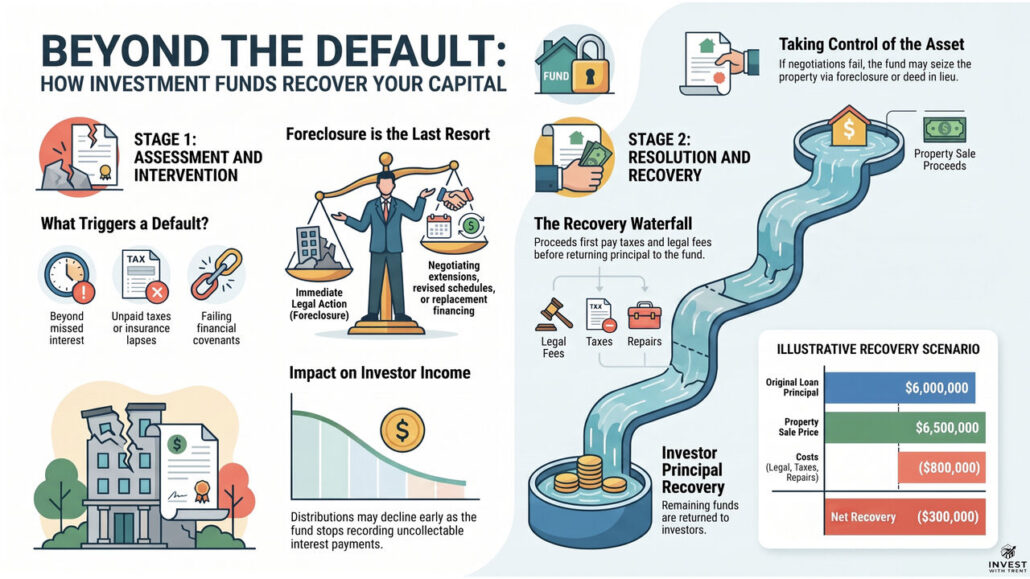
A borrower default does not automatically mean you lose money.
It means the fund’s original repayment plan has failed—and the manager must now recover the capital another way.
Because you invested in the fund rather than directly in one loan, the impact depends on the loan’s size, collateral, lien position and the fund’s diversification.
Here is what usually happens.
1. The borrower misses a payment or violates the loan terms
Default can involve more than unpaid interest.
The borrower might fail to pay property taxes, maintain insurance, complete required construction, meet financial covenants or repay the loan at maturity.
The lender typically sends a default notice and may begin charging default interest.
2. The manager evaluates the best recovery strategy
Foreclosure is not always the first move.
The manager may negotiate:
– A short extension
– Additional borrower equity
– A revised payment schedule
– A sale of the property
– A deed in lieu of foreclosure
– Replacement financing
A modification can be the best outcome when the property remains valuable and the borrower’s problem is temporary.
But extending a bad loan simply to avoid recognizing a loss can make the eventual recovery worse.
3. Income to the fund may decline
If the borrower stops paying, the fund may stop receiving current interest from that loan.
Distributions to investors may decline, even before any principal loss is known.
The fund may also stop recording accrued interest if collection is no longer considered probable.
4. The lender may take control of the property
If no acceptable solution is reached, the fund may foreclose, appoint a receiver where permitted or accept the property through a deed in lieu.
At that point, the fund may become responsible for taxes, insurance, repairs, security, leasing and property management.
This process can take months or years.
5. The property is stabilized or sold
The manager may sell immediately or invest additional capital to improve the recovery.
Once the property is sold, the proceeds generally pay:
1. Taxes and senior claims
2. Legal, foreclosure and selling costs
3. The fund’s outstanding loan principal and interest
4. Junior lenders and equity, if anything remains
If the fund is in first position and the collateral value is sufficient, it may recover all principal despite the default.
If net proceeds are insufficient, the fund recognizes a loss.
For example, assume the fund has a $6 million first mortgage.
The property sells for $6.5 million, but taxes, legal fees, repairs and commissions total $800,000.
Net recovery is $5.7 million.
The fund loses $300,000 of principal—even though it was first in line.
What does that mean for you?
You usually do not receive a separate bill or lose your entire investment because one borrower defaults.