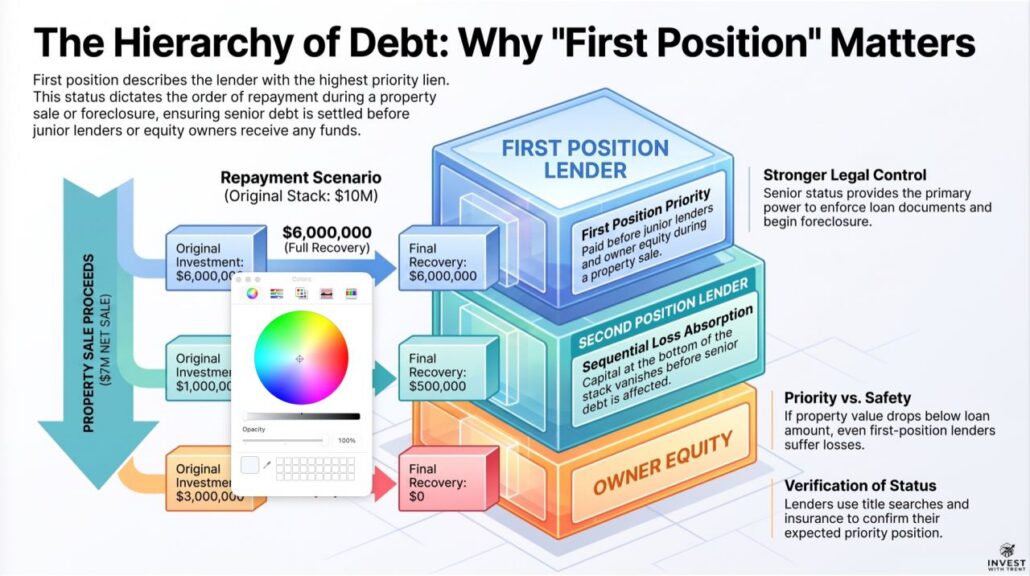
In real estate lending, “first position” refers to the lender whose lien generally has the highest priority against the property.
In plain English:
If the borrower defaults and the property must be sold, the first-position lender gets paid before the junior lenders and the owner’s equity.
Imagine a property with this capital stack:
– $6 million first-position mortgage
– $1 million second mortgage
– $3 million of owner equity
The property was originally worth $10 million.
Now suppose the borrower defaults and the property sells for only $7 million.
After $500,000 of legal fees, taxes, commissions and other costs, $6.5 million remains.
The first-position lender receives its $6 million first.
The second lender receives the remaining $500,000 and loses half its principal.
The owner receives nothing.
That is why lien position matters so much. The farther down the capital stack you sit, the more losses must be absorbed before your capital is affected.
How does a lender get first position?
The lender records a mortgage or deed of trust against the property. Priority is generally determined by applicable law and the order in which liens are recorded, although certain claims—such as property taxes or some statutory liens—may take priority even over a first mortgage.
Before making the loan, the lender typically obtains a title search and title insurance to confirm that its lien will be recorded in the expected position.
Why do lenders care so much?
Because first position provides two important advantages.
First, priority over the sale proceeds.
If the property is sold voluntarily or through foreclosure, the senior lender is generally repaid before second mortgages, mezzanine lenders and equity investors.
Second, stronger control when something goes wrong.
The first-position lender typically has the primary right to begin foreclosure, appoint a receiver where permitted, protect the property and enforce the loan documents.
Junior lenders may have rights, but those rights are limited by the senior lender’s documents and priority.
However, “first position” does not mean “risk-free.”
Suppose a lender makes a $7 million first mortgage against a property believed to be worth $10 million.
If the property ultimately produces only $5.5 million after foreclosure costs, the lender can still lose $1.5 million—even though it was first in line.
Priority determines who absorbs losses first.
It does not guarantee there will be enough money to repay everyone.
That is why sophisticated lenders evaluate more than lien position. They also examine:
– Loan-to-value
– Property cash flow
– Appraisal quality
– Borrower equity
– Market liquidity
– Environmental and title risks
– The realistic cost and timing of foreclosure