Want to stop being a landlord without giving up on real estate?
Most rental owners assume they have only two choices:
Keep owning properties or sell them and leave real estate altogether.
There’s a third option.
You can stop being the owner and become the lender.
Consider a $1 million rental property.
The lender provides a $650,000 first-position loan, while the owner contributes the remaining $350,000.
Both have money invested in the same property—but they occupy very different positions.
The owner receives the upside if rents increase and the property appreciates.
But the owner is also responsible for the tenants, vacancies, repairs, insurance, property management, and every unexpected expense.
More importantly, the owner’s $350,000 absorbs losses before the lender’s principal is exposed.
If the property eventually sells for only $800,000, the owner could lose $200,000 of equity.
The lender could still recover the entire $650,000 principal, assuming the valuation was accurate and foreclosure and selling costs don’t consume the remaining cushion.
That’s the tradeoff.
Equity owners receive potentially unlimited upside—but they’re last in line.
Lenders accept capped returns—but they’re paid before the equity owner.
I learned the importance of that distinction the expensive way.
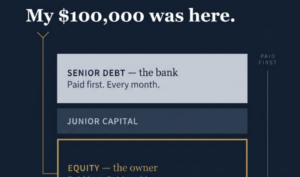
In 2021, I invested $100,000 as an equity investor in a multifamily property.
Interest rates increased, the property’s cash flow disappeared, and the value fell. I expect to lose my entire investment when the property is sold.
The lender didn’t need the property to become a great investment.
The lender simply needed it to remain valuable enough to repay the loan.
I needed everything left over after the lender was paid.
There wasn’t anything left.
That experience didn’t make me stop believing in real estate.
It made me reconsider where I wanted to sit in the capital stack.
Private real estate credit has risks. Borrowers default. Valuations can be wrong. Foreclosures can be expensive and slow. A first-position lien reduces risk; it doesn’t eliminate it.
But for someone approaching retirement, the objective may also be changing.
You may no longer need maximum appreciation.
You may need predictable income, less operational responsibility, and better protection if a deal underperforms.
Selling a rental doesn’t necessarily mean walking away from real estate.
Sometimes it simply means moving from the person responsible for everything to the person who gets paid first.