In 2021 my wife and I invested $100,000 in a multifamily equity syndication. Multifamily was selling at peak valuations, and to make the numbers work, the sponsor used floating-rate debt. Then rates spiked in 2022. We never received a single distribution. The building is slated to be sold this fall and I expect we’ll lose all $100,000.
This has happened to a lot of investors. So the question I want to answer today: why would you or I trust private real estate ever again?
This was one of my first investments as a limited partner and in hindsight I was a rookie at due diligence. I read every document we were given. I saw the variable rate. The problem is I didn’t flag it.
Then the Fed raised rates faster than it had in 40 years. Cash flow went to zero.
The $100,000 is gone. It’s the most painful loss I’ve taken as an investor.
For a lot of LPs who went through the same thing, the conclusion is that private real estate is a scam.
The truth is different.
There was no fraud. The operator didn’t steal anything. The building is real, it’s still standing, and it’s still mostly full of tenants paying rent every month. The property is generating income — just not enough to cover the increased debt service and still pay the limited partners.
But guess who still gets paid? The bank.
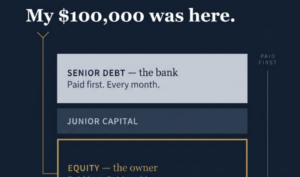
Every real estate deal has a capital stack. Debt service gets paid first. Operating expenses next. Reserves after that. Whatever survives all three goes to the equity investors.
As LPs in that syndication, my wife and I were last in line — and last in line means no money for us.
The problem with equity syndications is that for the equity partners to earn anything, almost everything has to go right. Interest rate assumptions, rent growth assumptions, exit cap assumptions, execution assumptions — all of them have to be nearly perfect.
Nothing in my career has ever required everything to go right at the same time and then delivered it. I’m sure you’d say the same.
So the lesson isn’t to avoid real estate. The lesson is to stop buying assumptions.
Today my wife and I invest in real estate debt — also known as real estate private credit.
The fund I’m invested in targets approximately 10% net annually, with monthly distributions generated from interest on short-term bridge loans secured by a portfolio of Class A properties. Across the portfolio, the loan-to-value ratio is an extremely conservative 45%.
As debt investors, we’re first in the capital stack. If things go wrong, the equity investors get wiped out entirely before we lose a single dollar of principal.
Same asset class. Same buildings. Entirely different seat.
Is it risk-free? No. Nothing is, but I’d rather have a claim on collateral than a claim on a forecast.
The $100,000 bought me that distinction. Expensive tuition, but given what I know now versus then, absolutely worth it.
If real estate private credit is something you’d like to learn more about, follow me here. More to come.