One of the simplest questions an investor can ask a fund manager is also one of the most revealing:
How much of your own money is invested alongside mine?
A manager can prepare an impressive presentation, explain a sophisticated underwriting process, and show attractive historical returns.
But a meaningful personal investment answers a more fundamental question:
Does the manager experience the consequences of those decisions alongside the investors?
In LCSF II, the answer is yes.
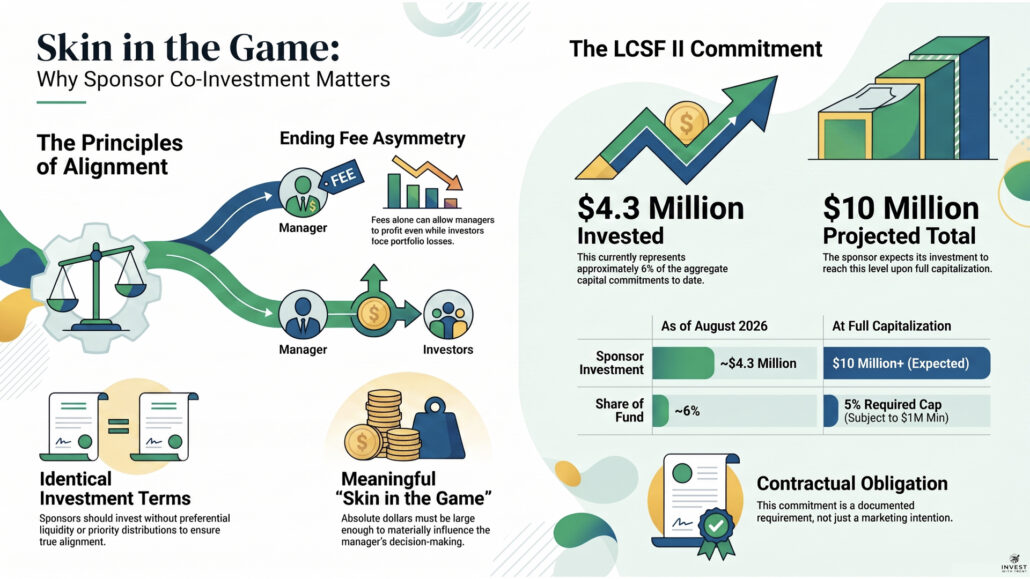
As of August 2026, the sponsor has invested approximately $4.3 million in LCSF II. That represents roughly 6% of aggregate capital commitments to date.
Under the fund’s governing documents, the sponsor is required to contribute an amount of up to 5% of aggregate capital commitments, subject to a minimum contribution of $1 million. Once the fund is fully raised, the sponsor expects its total investment to be at least $10 million.
That is not a symbolic commitment. It is meaningful capital exposed to the same underlying portfolio as the fund’s limited partners.
Why GP Co-Investment Matters
A fund manager earns management fees for operating a fund. Depending on the structure, the manager may also receive performance compensation if the fund achieves certain results.
Those incentives are not inherently problematic. A capable investment team should be paid for sourcing loans, conducting due diligence, managing the portfolio, servicing borrowers, and protecting investor capital.
But fees alone can create an asymmetry.
If the fund performs well, the manager earns fees and builds its business. If the fund performs poorly, investors bear the investment losses while the manager may still have collected fees along the way.
Meaningful GP co-investment reduces that asymmetry.
When the sponsor has millions of dollars invested in the same portfolio, a credit loss is not an abstract reduction in someone else’s return. It affects the sponsor’s own capital.
That does not guarantee better decisions, but it makes the consequences of those decisions more personal.
The Terms Matter as Much as the Amount
Simply stating that a manager has “skin in the game” is not enough.
Investors should ask how that capital is invested.
A sponsor could invest through a special class with better economics. It might receive priority distributions, reduced exposure to fees, preferential redemption rights, or the ability to withdraw its capital before ordinary investors.
Those arrangements would weaken the alignment implied by the headline co-investment number.
The LCSF II sponsor invests alongside LPs in the same vehicle and on the same terms, without side letters granting preferential liquidity.
That means the sponsor participates in the same underlying portfolio and is subject to the same general investment outcomes as other investors.
If liquidity is limited, the sponsor cannot simply move to the front of the redemption line through a private side agreement. If the portfolio experiences credit losses, the sponsor’s investment is exposed alongside LP capital.
This is the kind of alignment investors should look for.
Absolute Dollars and Percentage Both Matter
There are two ways to evaluate a GP commitment.
The first is the absolute dollar amount.
A manager who invests $50,000 in a $200 million fund can technically claim to be invested alongside LPs. But the amount may not be large enough to materially influence the manager’s behavior.
The second is the percentage of total capital.
A $4.3 million investment representing approximately 6% of current commitments is more significant. It means the sponsor is not merely satisfying a nominal requirement. It has contributed a meaningful share of the fund’s current equity.
As the fund grows, the percentage may change. That is why the expected minimum investment at full capitalization also matters. The sponsor anticipates having at least $10 million invested once the fund is fully raised.
The correct question is not whether the sponsor owns a few shares.
It is whether enough of the sponsor’s wealth is exposed for investment losses, liquidity constraints, and portfolio underperformance to matter.
Alignment Does Not Eliminate Risk
GP co-investment should never be confused with downside protection.
A manager can invest substantial personal capital and still make a bad loan. Sponsors can misjudge property values, underestimate construction costs, trust the wrong borrower, or fail to anticipate a market downturn.
Co-investment does not replace:
- Conservative loan-to-value ratios
- First-position collateral
- Experienced borrowers
- Independent appraisals
- Strong loan documentation
- Adequate reserves
- Portfolio diversification
- Disciplined servicing
- Responsible fund-level leverage
It is one part of the underwriting process investors should apply to the fund manager itself.
Investors should also understand whether the disclosed GP commitment consists of cash actually contributed, deferred fees, waived management fees, financed capital, or anticipated future contributions. Those forms of commitment do not necessarily create identical alignment.
The relevant figure for LCSF II is approximately $4.3 million invested as of August 2026—not merely pledged for some future date.
The Governing Documents Make the Difference
A verbal promise to co-invest can change.
A contractual requirement in the fund’s governing documents is more meaningful because it establishes an enforceable obligation rather than a marketing intention.
LCSF II’s documents require sponsor capital based on aggregate commitments, subject to the stated minimum. The sponsor’s expected investment of at least $10 million at full capitalization builds on that documented requirement.
This structure signals that GP commitment was designed into the fund rather than added later as a sales point.
The Question Behind the Question
When investors ask how much capital the sponsor has invested, they are not simply looking for a number.
They want to know whether the manager’s incentives remain aligned when a loan becomes difficult.
Will the manager extend a weak borrower to avoid recognizing a problem?
Will it reach for a higher yield to make the fund’s returns look more attractive?
Will it preserve underwriting standards when pressure to deploy capital increases?
Will it communicate transparently when performance falls short of expectations?
No co-investment amount can answer those questions conclusively. But a meaningful investment on the same terms gives the sponsor a direct financial reason to protect principal, maintain discipline, and address problems early.
As of August 2026, the LCSF II sponsor has approximately $4.3 million invested alongside LPs, representing about 6% of commitments to date. At full capitalization, it expects that commitment to reach at least $10 million.
That does not make the fund risk-free.
It does mean that when investors put their capital at risk, the sponsor has meaningful capital standing beside them.