A real estate debt fund makes money by lending against property and collecting interest.
So how does it lose money?
The borrower fails, and the collateral is not worth enough to make the lender whole.
Here is how that happens.
1. The property stops producing enough cash
Vacancy rises. Rents fall. Expenses spike. A renovation runs over budget. The borrower can no longer cover the loan payments.
One missed payment does not create a loss. It creates a problem. The loss comes if the problem cannot be fixed.
2. The property value falls below the loan balance
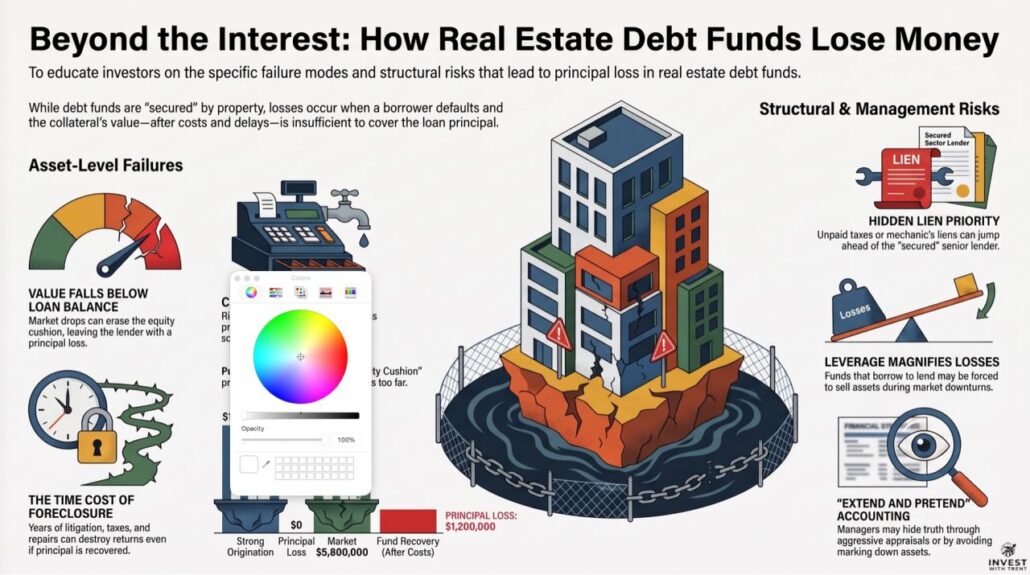
Suppose a fund lends $7 million against a property valued at $10 million.
The market weakens. The property sells for $6.2 million. After legal fees, taxes, commissions and other workout costs, the fund recovers $5.8 million.
That is a $1.2 million principal loss.
This is why loan-to-value matters. The borrower’s equity should absorb the first loss. But if values fall far enough, that cushion disappears.
3. The fund is not actually first in line
A lender may believe it holds a senior, secured position. But defective documents, unpaid property taxes, mechanic’s liens, environmental claims or title problems can reduce recovery.
“Secured” is only as good as the documentation, lien priority and collateral.
4. The workout takes too long
Foreclosure is not instant. A troubled loan may spend months or years in modification, litigation, bankruptcy or receivership.
Interest may stop while attorneys, property managers, taxes, insurance and repairs keep costing money.
Even if most principal is recovered, a long delay can destroy the return.
5. Too many loans fail together
Diversification helps only when the loans are truly diversified.
A fund concentrated in one market, borrower, property type or lending strategy can suffer multiple losses from one economic event.
6. The fund uses too much leverage
Some funds borrow money to make more loans.
That boosts returns when things work. It also magnifies losses and may force the fund to sell assets at the worst time.
7. The manager makes bad decisions—or hides the truth
Weak underwriting, aggressive appraisals, poor servicing, fraud, conflicts of interest and “extend and pretend” accounting can turn manageable problems into permanent losses.
For investors, the damage usually appears in stages:
Distributions fall. Redemptions are suspended. Assets are marked down. In the worst cases, investors lose principal.
The key point:
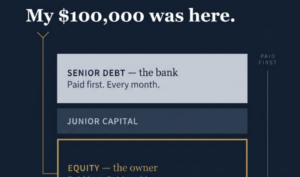
Debt sits ahead of equity, but it is not risk-free.
The right question is not, “Can this fund lose money?”
It can.
The better question is: What has to go wrong before I lose money, and how much protection stands between me and that outcome.