“H𝗼𝘄 𝗺𝘂𝗰𝗵 𝗱𝗼𝗲𝘀 𝘁𝗵𝗲 𝗳𝘂𝗻𝗱 𝗰𝗵𝗮𝗿𝗴𝗲?”undefined
That sounds like a simple question. It isn’t.
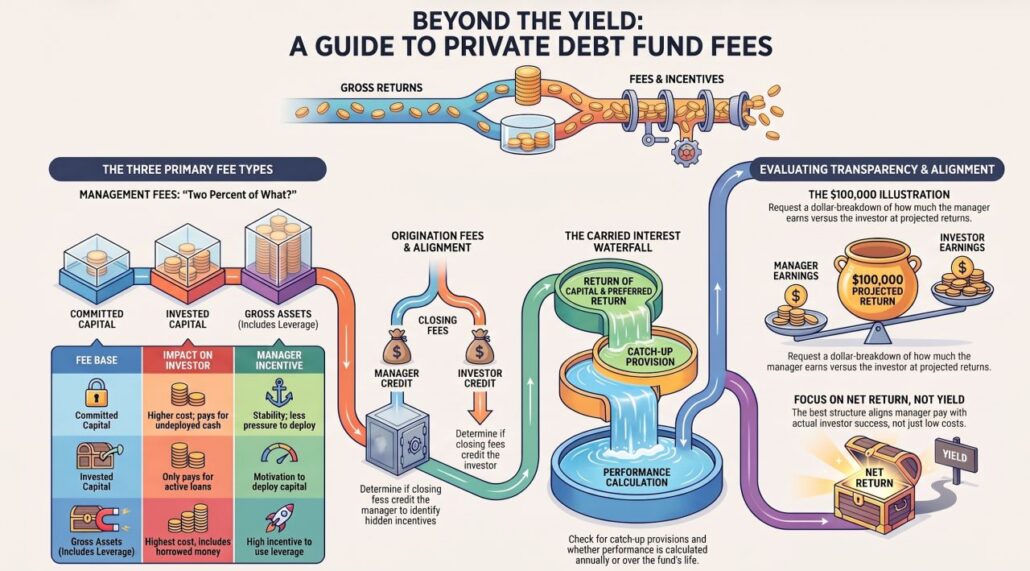
Private debt funds can collect fees from both investors and borrowers. The structure matters because two funds with the same gross return can produce very different net returns—and very different incentives.
Here are the three fees you’ll see most often:
1. Management fee
This pays the manager to operate the fund: source loans, perform underwriting, service the portfolio, manage defaults and report to investors.
It is commonly calculated as a percentage of:
* Committed capital
* Invested capital
* Net asset value
* Gross assets
Those are not interchangeable.
A 2% fee on invested capital may be reasonable. A 2% fee on committed capital—including cash that has not been deployed—costs you more. If the fund uses leverage and charges fees on gross assets, you could also pay fees on money the fund borrowed.
Always ask: “Two percent of what?”
2. Origination fees
Borrowers often pay an upfront fee when the loan closes—perhaps 1% to 3% of the loan amount.
On a $1 million loan, two points equals $20,000.
The critical question is: who receives that money?
Some funds credit origination fees to the fund, increasing income for investors. Others allow the manager or an affiliated company to keep them. Some split the fees.
The same questions apply to extension fees, exit fees, servicing fees, late charges and prepayment penalties.
If the manager keeps all these fees, it may have an incentive to originate more loans or encourage extensions—even when those decisions do not maximize investor returns.
3. Carried interest
Carried interest—sometimes called an incentive fee—is the manager’s share of the fund’s profits.
For example, investors might receive the first 8%, with the manager then receiving 20% of profits above that level.
But the waterfall can change the result dramatically.
Does the manager earn carry only after investors actually receive the preferred return? Is there a catch-up provision? Is performance calculated annually, loan by loan or over the fund’s entire life? Can the manager earn incentive fees in one year without returning them after future losses?
A structure that looks like “80/20 after an 8% preferred return” can work very differently depending on the fine print.
None of these fees is automatically unreasonable. A skilled manager should be paid for sourcing, underwriting and managing loans.
The issue is transparency and alignment.
Before investing, ask for one simple illustration:
“If I invest $100,000, the fund earns its projected gross return, and everything performs as expected, how many dollars go to the manager—and how many dollars reach me?”
Then ask for the same calculation if returns come in below target.
Do not evaluate a private debt fund by its advertised yield. Evaluate the net return after every fee, who receives each fee and what behavior the fee structure rewards.