Real estate equity and real estate debt can be backed by the same property while producing entirely different return profiles.
The equity investor is buying the building’s future.
The lender is financing the next stage of its business plan.
That distinction affects not only how much each investor might earn, but when returns are received, what must go right to earn them, and who absorbs the loss when something goes wrong.
Why Today’s Math Is Difficult for Equity
Consider a stabilized Class A apartment property trading at a 5% capitalization rate.
A 5% cap rate means the property generates $5 of annual net operating income for every $100 of purchase price before debt service and capital expenditures.
Now assume the buyer finances the acquisition with a commercial mortgage costing 6%.
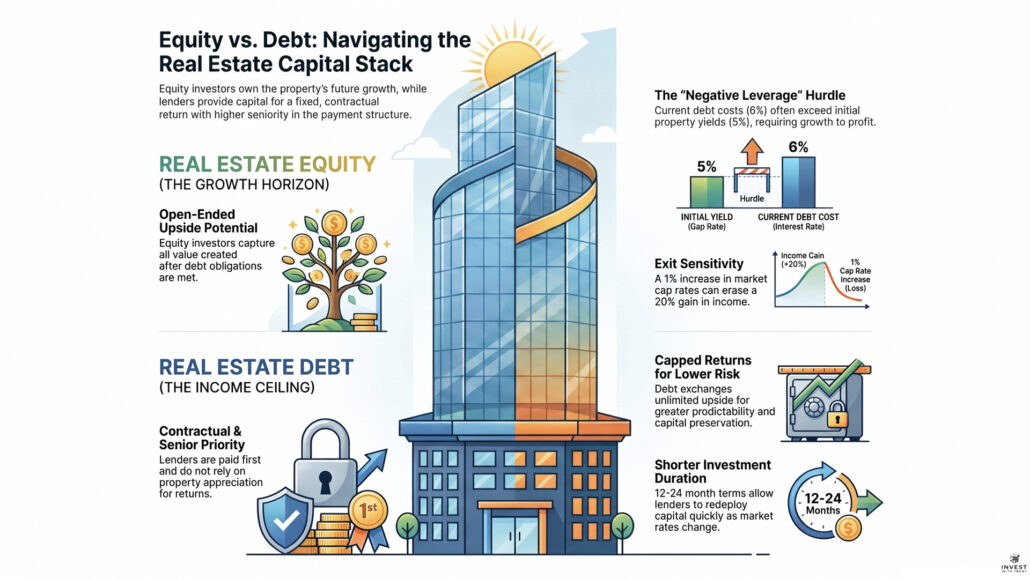
The property earns 5% before financing, but the debt costs 6%. This is commonly called negative leverage: the initial yield on the property is lower than the interest rate on the money used to acquire it.
Current market data supports the existence of this challenge. CBRE’s cap-rate research shows substantial variation by market and property quality, but many stabilized multifamily cap rates remain in the general range described above. Meanwhile, indicative rates for large stabilized multifamily loans have remained near or above those cap rates. CBRE’s H1 2026 survey also emphasizes that national averages can conceal meaningful differences among markets, classes, and strategies.
Negative leverage does not automatically make an equity investment bad. It means the property must create enough value elsewhere to overcome the unfavorable starting spread.
That can happen through:
- Rent growth
- Higher occupancy
- Expense reductions
- Renovations or operational improvements
- Principal paydown
- A lower exit cap rate
- Lower refinancing costs
The problem is that each of these outcomes requires time, execution, or favorable market conditions.
Equity Returns Depend Heavily on the Exit
Suppose investors purchase a $20 million apartment building at a 5% cap rate. The property therefore produces approximately $1 million of annual net operating income.
If the operator grows NOI to $1.2 million and the property is still valued at a 5% cap rate, its estimated value rises to $24 million.
That is the appeal of equity. A 20% increase in income produced a $4 million increase in value.
But capitalization rates can move in the opposite direction.
If NOI reaches $1.2 million but the market demands a 6% cap rate at the time of sale, the property is worth approximately $20 million. The operator improved income by 20%, yet cap-rate expansion absorbed the entire increase in estimated value.
This is why multifamily equity increasingly requires a longer investment horizon. Investors may need time for rent growth, operational improvements, and principal reduction to overcome today’s financing costs and uncertain exit pricing.
A decline in interest rates could help by lowering financing costs and supporting lower cap rates, but it is not the only path to a successful equity investment. Strong NOI growth can also create value when rates remain stable. The more important point is that equity returns usually depend on several future outcomes rather than the property’s starting yield alone.
Debt Offers a More Contractual Return
A lender approaches the same property differently.
Instead of purchasing the building, the lender may provide a two-year first-position loan at a contractual interest rate. If the borrower performs, the lender receives interest payments and repayment of principal at maturity.
The lender does not need the property to appreciate to earn the stated return.
It generally needs the borrower to make the required payments and successfully refinance, sell, or otherwise repay the loan.
This produces a return profile that is typically:
- More dependent on contractual income
- Less dependent on appreciation
- Shorter in duration
- Senior to the equity
- Capped at the negotiated interest and fees
In the current environment, private real estate loans may generate current income that compares favorably with the initial cash yield available from stabilized equity. Because the loan sits above the equity in the capital stack, the lender may also earn that income from a more protected position.
That combination can create an attractive risk-adjusted return—but it does not make the loan risk-free.
The Lender Gives Up the Upside
If the $20 million property eventually sells for $30 million, the equity investors participate in the gain after repaying the debt and transaction costs.
The senior lender does not.
The lender receives the principal, contracted interest, and any applicable fees. Once those obligations are satisfied, the remaining appreciation belongs to the equity.
Debt therefore exchanges open-ended upside for priority and greater predictability.
Equity exchanges predictability for growth potential.
Neither position is inherently better. The appropriate choice depends on what the investor needs the capital to accomplish.
Short Duration Creates Both an Advantage and a Risk
A private loan with a 12- to 24-month term allows the lender to respond relatively quickly to changing market conditions. When the loan is repaid, the capital can potentially be redeployed at then-current rates.
If rates remain elevated or increase, that can be advantageous.
If rates fall, however, the next loan may offer a lower return. Borrowers may also refinance early when cheaper capital becomes available, creating reinvestment risk for the lender.
Equity has the opposite duration profile. It may struggle under elevated rates in the near term, but a long holding period gives the property more time to grow income and potentially benefit from a more favorable capital-markets environment.
Two Different Ways to Be Paid
The difference between debt and equity is ultimately a difference in what the investor is being paid to accept.
The equity investor is paid for assuming operating risk, market risk, leverage risk, and uncertainty about the eventual sale price.
The lender is paid for providing capital, underwriting credit risk, accepting illiquidity, and relying on the borrower and collateral for repayment.
In today’s negative-leverage environment, conservatively structured private lending can sometimes offer more current income than stabilized multifamily equity while occupying a more senior position in the capital stack.
Equity may ultimately produce the larger total return—but more things must go right, and investors may need to wait longer for the thesis to play out.
Debt offers a ceiling.
Equity offers a horizon.
For investors prioritizing current income, shorter duration, and capital preservation, the ceiling may presently be the more attractive place to invest.