Real estate is commonly described as an inflation hedge.
The logic is easy to understand: when the cost of goods and services rises, landlords may be able to increase rents. Property values and replacement costs may also rise, allowing real estate income and values to keep pace with the declining purchasing power of a dollar.
But the relationship is not immediate—and it is not automatic.
A landlord cannot necessarily raise rents the moment inflation increases. Existing leases remain in effect until they expire. In a multifamily property, it may take 6 to 12 months to renew or replace enough leases for higher market rents to materially affect revenue.
Commercial leases can delay that adjustment for years unless they include contractual rent escalations.
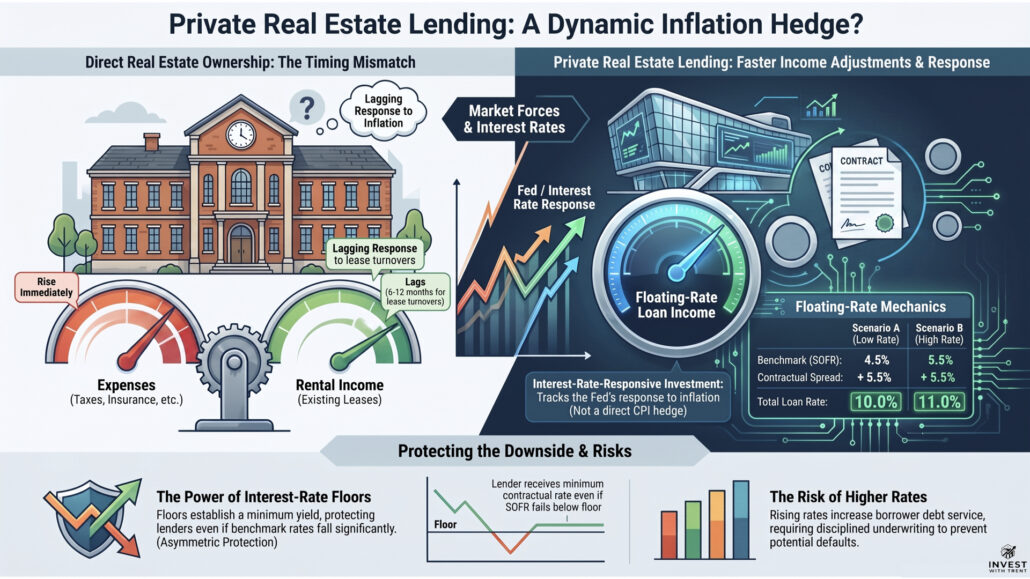
Meanwhile, property taxes, insurance, payroll, utilities, repairs, and construction costs may rise immediately.
That creates a timing mismatch: expenses can adjust to inflation before revenue does.
Does private real estate lending solve that problem?
In some circumstances, it can respond more quickly—but only when the loans are structured appropriately.
How Floating-Rate Loans Work
Many private real estate loans carry a floating interest rate rather than a fixed rate.
The loan’s rate is generally calculated using a benchmark plus a contractual spread. For example:
SOFR + 5.5%
The Secured Overnight Financing Rate, or SOFR, is a benchmark based on the cost of overnight borrowing collateralized by U.S. Treasury securities. It has become a common reference rate for floating-rate financial contracts.
If the applicable SOFR rate is 4.5%, the borrower’s interest rate would be 10%.
If SOFR subsequently increases to 5.5%, the loan rate would reset to 11%, subject to the timing and terms in the loan agreement. That reset might occur monthly, quarterly, or at another specified interval.
The higher payment from the borrower can result in additional interest income for the lender and, potentially, higher distributions to investors.
That is considerably faster than waiting for every lease in an apartment building to turn over.
Is That Really an Inflation Hedge?
Not exactly.
A floating-rate loan is better described as an interest-rate-responsive investment than a direct inflation hedge.
SOFR does not track the Consumer Price Index. It reflects conditions in short-term financing markets. However, inflation and short-term interest rates are often connected because the Federal Reserve may raise its policy rate when inflation is too high.
Higher policy rates tend to increase short-term market rates, including the benchmarks used in many floating-rate loans.
That is what happened during the inflationary period beginning in 2021. Inflation accelerated, the Federal Reserve tightened monetary policy, benchmark rates rose, and income from many floating-rate loans adjusted upward.
By contrast, owners of fixed-rate bonds and other fixed-income investments continued receiving the same number of dollars even though those dollars purchased less.
The distinction matters. Inflation can remain elevated while interest rates hold steady or decline. A floating-rate loan therefore does not provide the direct inflation linkage of an inflation-indexed security.
What it can provide is a mechanism for investment income to adjust when the interest-rate environment changes.
The Importance of an Interest-Rate Floor
A well-structured private loan may also include an interest-rate floor.
Suppose a loan is priced at SOFR plus 5.5%, with a 3% SOFR floor. The contractual calculation would use the greater of the current SOFR rate or 3%.
If SOFR is 4.5%, the borrower pays 10%.
If SOFR falls to 2%, the floor applies, and the borrower still pays 8.5%.
This creates a potentially attractive asymmetry for the lender:
- When benchmark rates rise, the loan’s income may rise with them.
- When benchmark rates fall below the floor, the loan’s rate stops declining.
The floor does not guarantee an investor’s overall return. Fund expenses, loan losses, idle cash, changes in leverage, and management fees can all affect the amount ultimately distributed. Borrowers may also refinance or repay loans early when rates fall, forcing the lender to reinvest at lower prevailing yields.
Nevertheless, floors can help establish a minimum contractual yield on a performing loan for as long as that loan remains outstanding.
Higher Rates Also Create Higher Risk
There is another side to floating-rate lending that investors should not ignore.
Every additional dollar of interest received by the lender is an additional dollar the borrower must pay.
If a property’s income does not rise as quickly as its debt service, the borrower’s coverage ratio can deteriorate. A loan that appeared comfortable at 9% may become considerably tighter at 11%.
That is why floating rates cannot substitute for disciplined underwriting.
The lender still needs to evaluate the property’s current cash flow, the borrower’s liquidity, the loan-to-value ratio, the interest reserve, and the ability of the project to withstand higher rates or a longer-than-expected exit. Collateral may reduce the severity of a loss, but it does not eliminate the possibility of default.
A Different Kind of Protection
Direct real estate and private real estate lending respond to inflation differently.
Property ownership may provide long-term protection through rising rents, increasing replacement costs, appreciation, and the use of fixed-rate debt that becomes cheaper in real terms. But the benefits may arrive slowly, and rising operating costs can absorb much of the increase.
Floating-rate private lending can respond faster when inflation leads to higher short-term interest rates. Interest-rate floors may also help preserve loan income when those rates later decline.
So, does private lending offer the same inflation protection as owning real estate?
No—not in precisely the same way.
But when loans are conservatively underwritten, floating-rate, and protected by appropriate floors, private lending can offer something many traditional fixed-income investments cannot: income with the ability to adjust to a changing rate environment while retaining a contractual minimum.
For investors concerned about preserving both capital and purchasing power, that distinction is worth understanding.