It is reasonable to be skeptical of any investment manager claiming a zero-loss track record.
“Zero losses” can mean different things. It might mean no investor has lost principal. It might mean no loss has been formally recognized yet. Or it might exclude loans that were modified, extended, sold, or transferred elsewhere.
So the first question should never be, “Is the number impressive?”
It should be, “Exactly how is that number being calculated?”
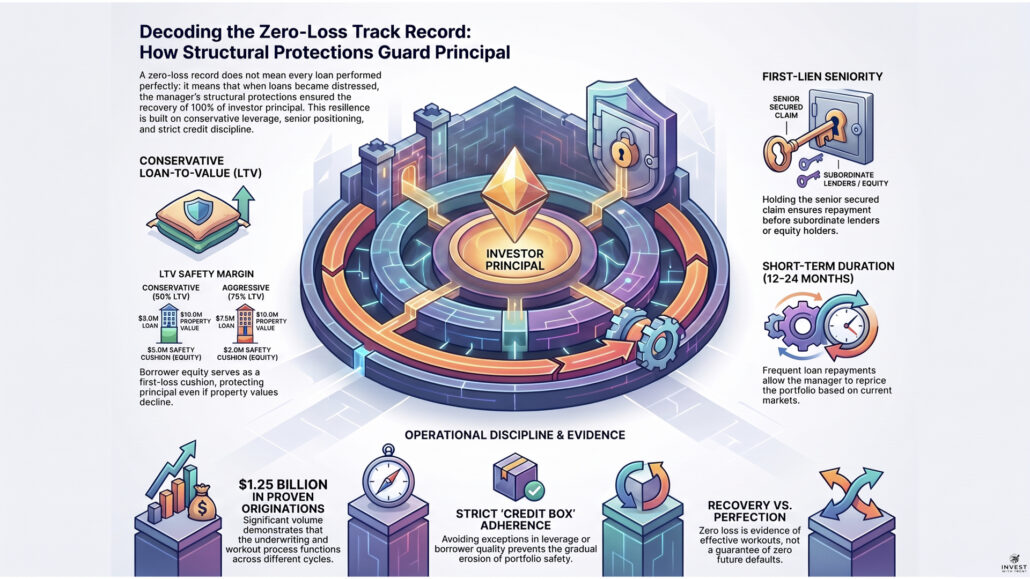
In our case, the relevant claim is that across more than $1.25 billion in loan originations, the manager has experienced zero realized losses of investor principal to date.
That does not mean every borrower paid on time. It does not mean every loan performed exactly as expected. And it certainly does not mean future losses are impossible.
It means that when loans became distressed or non-performing, the manager’s historical recoveries ultimately returned 100% or more of the investor principal associated with those investments, plus some, if not all, accrued default interest and fees.
That outcome is primarily the result of what happens before a loan is made.
The First Line of Defense Is a Conservative LTV
Loan-to-value ratio measures the size of the loan relative to the value of the property securing it.
If a lender makes a $5 million loan against a property worth $10 million, the starting LTV is 50%. The property could theoretically decline substantially in value before the lender’s principal became exposed.
Contrast that with a $7.5 million loan against the same property. At 75% LTV, a relatively ordinary combination of declining property value, legal costs, unpaid taxes, selling expenses, and deferred maintenance could begin consuming lender principal.
The borrower’s equity is the lender’s first-loss protection.
The more equity beneath the loan, the larger the cushion available when the original business plan does not work.
That does not eliminate risk. Appraisals can be wrong, property values can fall, and enforcement can be more expensive than anticipated. But conservative leverage gives the manager more ways to solve a problem without asking investors to absorb a principal loss.
First-Lien Position Matters When Something Goes Wrong
Being secured by real estate is not enough. Investors also need to know where the loan sits in the capital stack.
A first-lien lender generally has the senior secured claim against the property, ahead of subordinate lenders, preferred equity, common equity, and the borrower’s own capital.
Those junior positions absorb losses before the first mortgage does.
This is fundamentally different from making mezzanine loans or holding preferred equity behind a highly leveraged senior loan. Those investments may advertise higher returns, but they begin taking losses much sooner when property values decline.
First-lien status does not guarantee repayment. Certain taxes, legal expenses, protective advances, and other claims can affect the final recovery. But starting at the top of the capital stack materially improves the lender’s position if the borrower defaults.
Shorter Loans Allow the Portfolio to Reprice
Most loans in this strategy have initial terms of approximately 12 to 24 months.
The benefit is not that a 24-month loan is somehow immune to a real estate downturn. It is that the portfolio is not committing to today’s underwriting assumptions for the next seven or ten years.
As loans repay, the manager can reevaluate current interest rates, property values, borrower liquidity, construction costs, and market conditions before putting that capital back to work.
If conditions deteriorate, new loans can be made at lower leverage, with stronger reserves, tighter covenants, or not made at all.
Short duration also creates more opportunities to identify changes in risk one loan at a time. However, the contractual maturity date should not be mistaken for guaranteed liquidity. A troubled 18-month loan can remain outstanding much longer if it must be extended, restructured, foreclosed upon, or resolved through bankruptcy.
Staying Inside the Credit Box Is the Hard Part
Most serious credit losses do not begin on the day a borrower stops paying.
They begin on the day the lender makes an exception.
Perhaps the borrower has an excellent résumé, so the manager accepts more leverage. Perhaps the property is in a fashionable market, so the manager relies on aggressive rent growth. Perhaps capital is sitting idle, so the underwriting team approves a loan it would normally reject.
One exception rarely destroys a portfolio. But repeated exceptions gradually change what the fund actually owns.
A disciplined credit box establishes limits for leverage, lien position, borrower experience, property type, geography, liquidity, and exit assumptions. Staying inside that box sometimes means turning down attractive-looking loans and allowing investor capital to remain temporarily undeployed.
That can reduce short-term fee income for the manager. It can also prevent long-term principal losses for investors.
A Zero-Loss History Is Evidence, Not a Guarantee
More than $1.25 billion of originations provides meaningful evidence that the underwriting and workout process has functioned across a substantial volume of loans.
But investors should not translate “zero realized principal losses to date” into “principal cannot be lost.”
They should still ask:
- Are any loans currently delinquent, impaired, extended, or in foreclosure?
- How are modified loans classified?
- Are realized losses reported across every fund and account managed under the strategy?
- Has the manager ever taken title to a property?
- How long did prior workouts take?
- Were investor distributions reduced or delayed during those workouts?
- Does the track record include a full cycle for the property types being financed?
The strongest explanation for a zero-loss track record is not that every loan performed perfectly. It is that the loans were structured with enough protection that imperfect outcomes did not become principal losses.
That is the real purpose of conservative credit underwriting.
You do not underwrite on the assumption that nothing will go wrong. You structure the loan so that when something inevitably does, there is still a credible path to getting investor capital back.