
There’s a guy I know – mid-50s, owns a services business, solid net worth – who told me last year he was done with tenants. 15 years of rental properties. Good returns. But the 2am phone calls, the contractor drama, the eviction timelines… he was over it.
His advisor introduced him to a debt fund. Within 90 days he had capital working. Monthly checks hitting his account. And he hadn’t dealt with a single maintenance call.
That got my attention. So I dug in.
Here’s the thing. If you’ve built real wealth – whether through a business, a career, or both – and you want income from real estate without actually owning real estate, debt funds are worth understanding. The math is interesting and the structure solves a real problem.
So let me walk you through what a debt fund actually is, how the money works, and what you need to check before you put a dollar in.
A Debt Fund Works Like a Private Bank
Strip away all the jargon and a debt fund does one thing. It pools money from investors and lends it out — with real estate as collateral.
Banks do this every day. The difference is that a debt fund targets borrowers banks usually can’t help. Think real estate flippers. Bridge-loan buyers. People who need money fast and can’t wait 60 days for a conventional lender to process paperwork.
The fund makes the loan. The borrower pays interest. That interest flows back to you as income.
That’s the whole model.
Companies like Dynamo Capital, Aspen Funds, and Leeward all run versions of this. They pool investor money, underwrite short-term real estate loans, and send distributions back to investors.
How the Structure Works — and Why Being a “Limited Partner” Matters to You
Most debt funds are set up as an LLC or a taxed partnership. You come in as a limited partner, that’s the LP. The people running the fund are the general partners, the GPs.
The GPs do all the work. They find borrowers. They underwrite loans. They handle the accounting, the servicing, and if somebody stops paying, they handle the foreclosure.
Your job as an LP? Put in capital. Receive distributions. That’s it.
And here’s the part that matters: your liability is limited to whatever you invested. Your house, your other accounts, your personal assets — they’re not on the line.That’s a big deal. Because if you buy a rental property yourself, your exposure can go way beyond the purchase price.
Why the Returns Can Beat Owning Rentals
This is where it gets interesting.
- You get paid immediately. With an equity deal — buying a property, fixing it up, renting it out — you might wait years before you see real income. Debt funds pay monthly. Your capital starts earning from day one.
- The yields are higher than most people expect. Because these funds charge borrowers more than a regular bank would, the effective returns to investors often land between 10% and 18%. That’s not a typo.
- Your money is spread across lots of loans. Instead of sinking $200,000 into one property and hoping nothing goes wrong, your capital gets divided across dozens or hundreds of loans. If one borrower defaults, it doesn’t wreck the whole thing.
- It’s actually passive. No tenants. No contractors. No HOA meetings. No 2am phone calls. The GP runs everything. You check the mailbox.
Why Debt Sits Above Equity (This Is the Part Most People Miss)
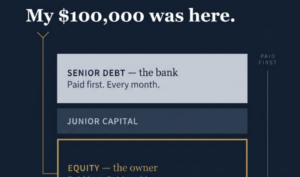
When the fund makes a loan, that loan is secured by a mortgage on the property. Usually in first position. That means if the borrower stops paying, the fund gets its money before the equity holder sees a cent. The property itself is the backstop.
Good funds keep their loan-to-value ratios around 75% or lower. So there’s a 25% cushion built in. Property values would need to fall by more than 25% before your money is at risk.
And here’s another thing most people don’t think about. These loans are short-term — usually 6 to 12 months. So the fund isn’t stuck with yesterday’s interest rates. When rates go up, new loans get written at higher rates. That’s built-in protection you don’t get with a 30-year rental mortgage.
Liquidity: Not a Stock, But Not a 10-Year Lockup Either
Let’s be honest about this. Debt funds are not liquid like a brokerage account. Most have a 12- to 24-month lock-up with a 90-day notice if you want your money back.
But compare that to owning a rental property. Selling a house takes months. Selling inside an equity fund can take 5 to 7 years.
Debt funds create natural liquidity because the loans keep paying off. New money comes in, old loans mature, and the manager keeps reinvesting. It’s not instant access. But it’s a lot faster than waiting for a property to close.
Due Diligence: 3 Things to Check Before You Write a Check
This is where most investors skip steps. Don’t be that person.
Before you put money into any debt fund, demand three things:
- The loan tape. Every serious fund keeps a master spreadsheet of every loan in the portfolio — borrower info, credit scores, LTV ratios, appraisal values. If they won’t show it to you, walk away. Period.
- Verification sampling. Don’t just read the spreadsheet — check it. Best practice is to pick 15% to 20% of the loans at random and verify the backup documents yourself. Background checks. Appraisals. Bank statements. Compare what you find to the fund’s written process.
- Public record confirmation. Go to the county records and confirm the loans are actually filed. If the mortgage is recorded, the loan exists and the fund has a real legal claim on the property. If it’s not filed, the collateral is not real.
This is not being paranoid. This is the minimum you should do before putting serious money into a private vehicle.
Quick Decision Guide: Is a Debt Fund Right for You?
- A debt fund makes sense if: you want steady income, you don’t want to manage property, you have capital sitting in low-yield accounts, and you’re okay with a lock-up period.
- Think twice if: you need your money available at any time, you’re not comfortable with private fund structures, or you’re not willing to do the due diligence I described above.
- Where to start looking: Dynamo Capital, Aspen Funds, and Leeward — three firms that offer debt fund strategies backed by real estate. Compare their LTV policies, their track records, their distribution history, and their lock-up terms before you commit.
What to Do Next
Debt funds are not magic. They have real risk and lock-up periods. And they require real homework.
But for the right person — someone who has capital, wants income, and is done dealing with tenants and toilets — this is one of the most interesting tools in the alternative investment space right now.
I went deep on this in a recent interview on the Invest With Trent show. We covered the full mechanics, the risk model, and the exact due diligence process you should follow — including real examples of how experienced operators underwrite these loans.
Watch it. Take notes. And do the homework before you write the check.