For many accredited investors, the largest pool of capital available for private investments is inside an IRA.
That creates an important question:
If the underlying fund makes leveraged real estate loans, will my IRA owe unrelated business income tax?
Based on the structure described, an IRA investment in LCSF II would generally not be expected to generate UBIT solely from the fund’s ordinary REIT dividends.
The reason is not simply that the investment involves real estate. It is that LCSF II is structured as a real estate investment trust, or REIT, rather than passing its operating income directly through to investors as a partnership.
That structural distinction matters.
Why UBIT Exists
Traditional and Roth IRAs generally allow investments to grow without current income taxation at the account-owner level. But that protection does not extend automatically to every type of income.
If an IRA directly participates in an active trade or business, it may receive unrelated business taxable income, commonly called UBTI. The resulting tax is called unrelated business income tax, or UBIT.
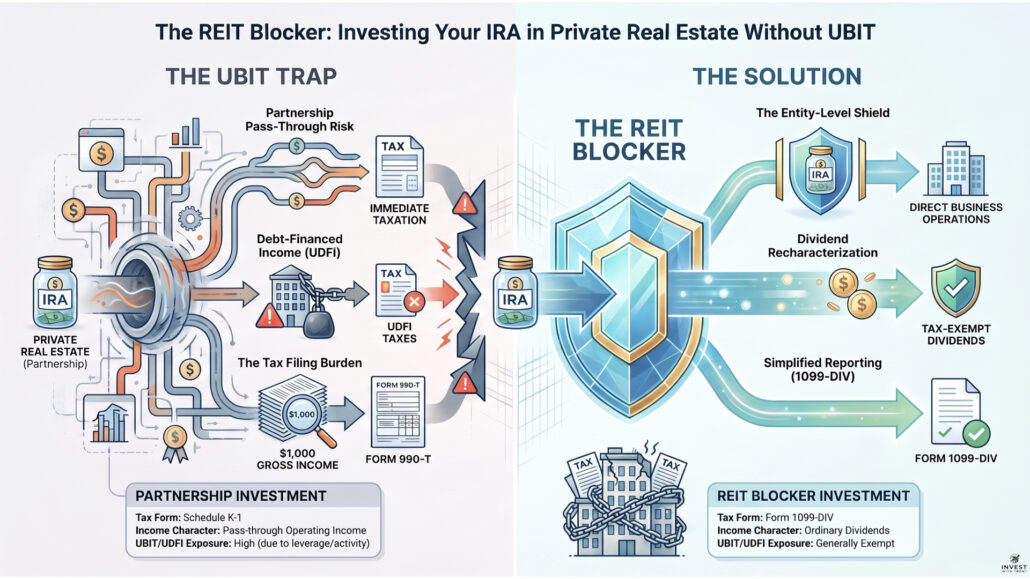
This frequently becomes an issue when an IRA invests in a limited partnership or LLC taxed as a partnership.
Partnerships are generally pass-through entities. The tax characteristics of their income pass through to their partners, including tax-exempt investors. If the partnership generates operating business income, the IRA may receive its share of UBTI even if no cash is distributed.
A second issue can arise when an investment uses debt. Income attributable to debt-financed property may be treated as unrelated debt-financed income, or UDFI, which is generally included in the UBIT calculation.
If an IRA has $1,000 or more of gross income from an unrelated business, a Form 990-T filing may be required. The tax is paid from the IRA’s assets, not from the account owner’s personal checking account. The IRS explains the general filing threshold and UBIT framework, although the application to a particular IRA investment depends on its structure.
How a REIT Changes the Tax Character
A REIT is generally taxed as a corporation that has elected special treatment under the Internal Revenue Code.
Instead of passing each underlying item of operating income, interest expense, and debt-financed income directly through to shareholders, the REIT calculates its income at the entity level and then pays dividends to its investors.
Ordinary dividends are generally excluded when calculating unrelated business taxable income under Section 512(b)(1) of the Internal Revenue Code.
That is why private REITs are often described as UBIT blockers.
The REIT sits between the retirement account and the underlying lending activity. The REIT may originate loans, collect interest and fees, use qualifying entity-level leverage, and distribute earnings to its shareholders as REIT dividends.
The IRA owns shares in the REIT. It does not directly own an interest in each underlying loan or operating partnership.
As a result, the REIT can change income that might have created UBTI if earned directly into dividend income that is generally excluded from UBTI when received by the IRA.
Why the Tax Form Matters
LCSF II reports distributions as REIT dividends on Form 1099-DIV rather than issuing investors a Schedule K-1 reporting partnership income.
A portion of those dividends may be identified as Section 199A dividends.
For a taxable individual investor, qualified REIT dividends may be eligible for the Section 199A deduction, subject to the investor’s particular circumstances and current tax law.
Inside an IRA, however, the Section 199A deduction is generally not the central issue. The account is already tax-advantaged, and the individual ordinarily does not claim a current deduction for income earned inside it.
The more important point is the character of the payment: the investor is receiving a REIT dividend rather than a direct allocation of partnership operating income.
The Form 1099-DIV reporting supports that treatment, but the form itself does not create the UBIT protection. The protection comes from the fund’s legal and tax structure and the application of the tax code to the distributions.
What the REIT Blocker Does—and Does Not—Do
The REIT structure generally prevents the fund’s internal leverage from flowing through to the IRA as if the IRA had borrowed the money itself.
But there are still circumstances in which an IRA investor could face tax or compliance issues.
For example, if the IRA itself borrows money to purchase the REIT shares, the debt-financed income rules may apply. Special rules can also affect controlled entities, unusual distribution types, taxable REIT subsidiaries, or investments that do not maintain their intended REIT qualification.
An investor must also avoid prohibited transactions.
Using IRA-owned investments for personal benefit, transacting with certain disqualified persons, personally guaranteeing IRA debt, or moving expenses and income improperly between the IRA and the investor can create consequences much more serious than UBIT—including potential loss of the account’s tax-advantaged status.
The REIT blocker addresses the character of the fund’s income. It does not cure a prohibited transaction or protect an investor who structures the IRA’s purchase improperly.
Questions to Ask Before Investing
Before placing a private real estate investment inside an IRA, an investor should confirm:
- Is the investment held through a REIT, corporation, partnership, or disregarded LLC?
- Will the investor receive Form 1099-DIV or Schedule K-1?
- Does the sponsor expect any UBTI or UDFI to be allocated?
- Does the IRA itself use debt to make the investment?
- Has the custodian approved the asset type?
- Are there any personal guarantees or prohibited-transaction concerns?
- Has the investor’s tax adviser reviewed the offering documents?
For LCSF II, the intended answer is straightforward: the fund is structured as a REIT, and ordinary investor distributions are reported as REIT dividends on Form 1099-DIV rather than as partnership income on Schedule K-1.
That structure is specifically designed to make the investment more suitable for IRAs and other tax-exempt investors.
Accordingly, an IRA investing with unborrowed funds would generally not be expected to incur UBIT solely because LCSF II uses leverage or conducts lending activity inside the REIT.
That is the practical benefit of the blocker.
It is still not individualized tax advice. Before investing, each investor should have a qualified tax professional confirm the treatment based on the final offering documents, account type, custodian, and personal circumstances.