Many investors consider multifamily real estate one of the safer ways to invest in property.
People always need a place to live. A 200-unit apartment building is not dependent on a single tenant. Rents can adjust over time, and a well-located property may appreciate for decades.
All of that may be true.
But it does not answer the most important question:
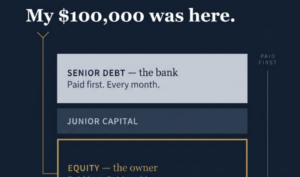
Where do you sit in the capital stack?
Two investors can put money into the same apartment building and experience dramatically different outcomes. One owns the equity. The other finances the property through a senior mortgage.
They have exposure to the same underlying asset—but not the same risk.
Equity Absorbs the First Loss
Suppose an apartment building is purchased for $20 million using:
- $15 million of debt
- $5 million of investor equity
The loan represents 75% of the property’s value, while investors contribute the remaining 25%.
If the property performs well, the equity investors receive the upside after operating expenses and debt service. They may benefit from cash flow, appreciation, principal paydown, tax advantages, and improved value created through better operations.
That upside is why people invest in multifamily equity.
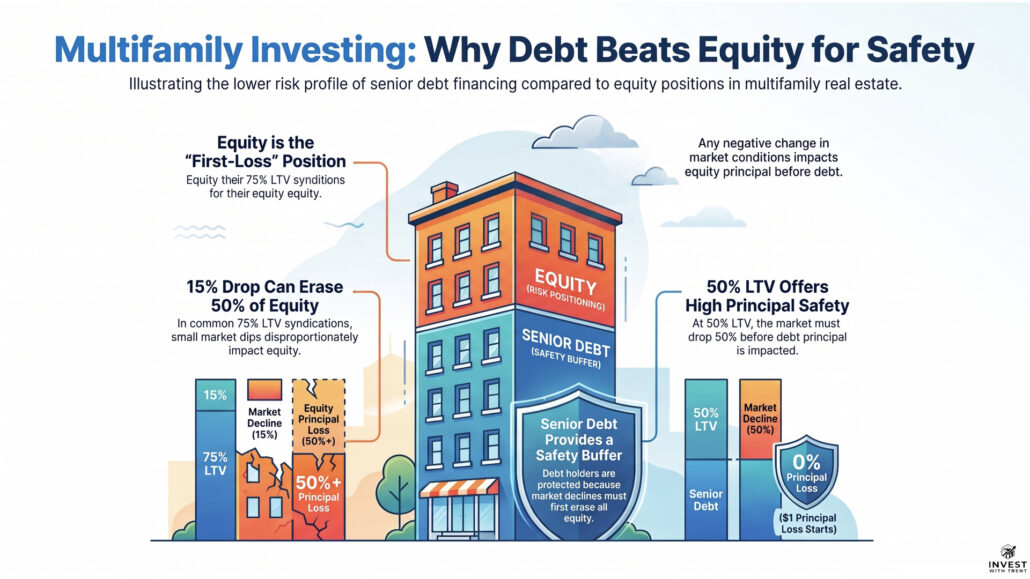
But equity also occupies the first-loss position.
If the property’s value falls by 15%, it is now worth $17 million. Assuming the debt remains at $15 million, the investors’ equity has declined from $5 million to $2 million.
The property lost 15% of its value.
The investors lost 60% of their equity.
At 70% leverage, the math is slightly less severe but still striking. A $20 million property financed with $14 million of debt begins with $6 million of equity. A 15% decline reduces the property’s value to $17 million, leaving $3 million of equity—a 50% reduction.
This is the effect of leverage. It magnifies gains when values rise and magnifies equity losses when they fall.
The Senior Lender Has a Different Position
Now consider an investor financing the same property with a first-position loan at 50% loan-to-value.
On a property valued at $20 million, the loan would be $10 million. The borrower would have $10 million of equity beneath the lender.
If the property’s value declined by 15%, it would still be worth $17 million against a $10 million loan. The borrower’s equity would absorb the entire $3 million decline, while the lender’s principal would remain covered by $7 million of equity.
The property’s value would have to decline to the outstanding loan balance before the original equity cushion was fully exhausted.
At 50% LTV, that means a theoretical 50% decline.
This does not mean the lender cannot experience problems until the property loses exactly half its value. Interest, legal expenses, protective advances, selling costs, and foreclosure delays can reduce the lender’s recovery. Appraisals can also be wrong, and a distressed sale may produce less than an orderly-market valuation.
But the basic principle remains: lower leverage creates a larger buffer between a decline in property value and an impairment of the lender’s principal.
Safety Depends on the Attachment Point
In lending, the “attachment point” describes where the lender’s capital begins to face loss.
A senior mortgage made at 50% LTV attaches after the borrower’s 50% equity position. That equity must generally absorb losses before the senior lender’s principal is impaired.
A mezzanine loan beginning above a 70% senior mortgage occupies a very different position. So does preferred equity, which may be called “debt-like” but is normally subordinate to the property’s mortgage.
The word “income” or “credit” in an investment’s name does not establish its safety. Investors need to know:
- Is the loan secured by a recorded first-position mortgage?
- What is the total leverage ahead of and including the investment?
- Is LTV based on the property’s current value or a projected future value?
- Has the property already achieved its expected rents and occupancy?
- Is additional debt permitted?
- What expenses would be incurred if the lender had to take control?
The answers determine how much real protection exists.
A Low LTV Does Not Eliminate Risk
Even a conservative senior loan can lose money.
A borrower may stop making payments long before the collateral value falls below the loan balance. A lender can then face months of unpaid interest, property taxes, insurance, legal fees, and foreclosure expenses.
Physical problems may be discovered after closing. Operating income may decline. Fraud can undermine an otherwise sensible transaction. Local laws can delay enforcement. A fund may also introduce risks unrelated to the property, including excessive fund-level leverage, poor diversification, inadequate liquidity, or weak servicing.
Regulators likewise emphasize that commercial real estate lending requires prudent underwriting and risk management throughout the economic cycle—not simply an appraisal and a lien. The OCC’s commercial real estate guidance addresses the risks inherent in acquisition, development, construction, and income-producing real estate lending.
This is why I would describe conservatively structured senior debt as better protected, not risk-free.
The Tradeoff Between Upside and Protection
Equity and senior debt serve different purposes.
Equity offers potentially unlimited upside. If the operator grows income, improves the property, and sells into a favorable market, equity investors may earn substantially more than the lender.
The senior lender generally gives up that upside. Its return is limited to the contracted interest, fees, and other negotiated economics.
In exchange, the lender receives priority.
Before equity investors receive sale proceeds, the senior loan must generally be repaid. Before equity investors realize appreciation, they must first preserve enough property value to cover the debt. When market conditions deteriorate, their capital absorbs the initial decline.
The real question, therefore, is not whether multifamily is safe.
It is whether you want to own the first-loss position in the property or finance it from a more senior position with a substantial equity cushion beneath you.
For investors prioritizing capital preservation and current income over maximum appreciation, financing a strong multifamily property at a conservative LTV may offer a more compelling risk position than owning its equity.
Same building. Same tenants. Very different investment.