Want to increase your income from your real estate holdings? Your best rental property may be the first one you should sell.
That sounds completely backward.
Most investors look at the property that appreciated the most, has the smallest mortgage, and has never given them much trouble—and conclude:
“This is the one I’ll never sell.”
But that may be the property with the worst return on your current equity.
Consider a simple example.
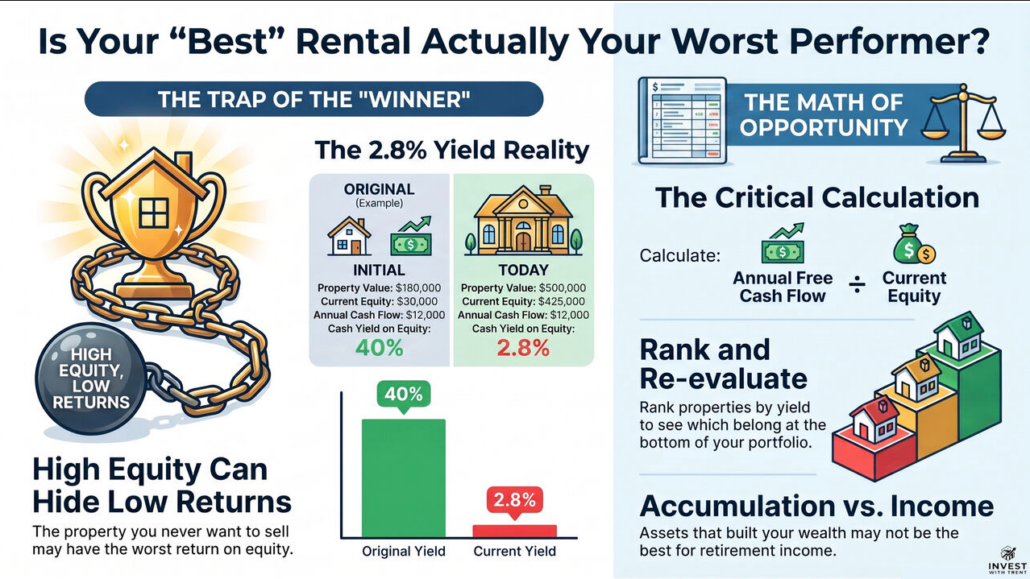
You bought a rental for $180,000 twelve years ago.
Today, it’s worth $500,000 and you owe just $75,000.
That means you have $425,000 of equity in the property.
After property management, repairs, insurance, taxes, vacancy, and debt service, it produces $1,000 per month in free cash flow.
That’s $12,000 a year on $425,000 of equity.
Your current cash yield on equity is just 2.8%.
Was it a good investment?
Absolutely.
It may have produced substantial appreciation, principal paydown, tax benefits, and income over the years.
But “Was this a good investment?” and “Is this still the best place for my money?” are two entirely different questions.
The price you originally paid is no longer the number that matters.
If you wouldn’t invest $425,000 today to receive $12,000 a year—and accept the concentration, illiquidity, repairs, and tenant risk that come with it—then keeping the property deserves another look.
This doesn’t automatically mean you should sell.
Capital-gains taxes, depreciation recapture, future appreciation, financing terms, and your broader portfolio all matter.
But many rental owners keep their most appreciated property because it feels like their biggest winner.
In reality, it may simply be where the largest amount of their capital is producing the least spendable income.
A great accumulation asset can become a mediocre retirement-income asset.
For every rental you own, calculate this:
Annual free cash flow ÷ current equity
Then rank the properties from highest to lowest.
The property you’ve always considered your best investment may be sitting at the bottom.
Want to learn more about how investing in a real estate private credit fund can yield approximately 10% with monthly income? Follow me here.