“Don’t worry—the sponsor has plenty of skin in the game.”
That sounds reassuring.
But unless you know what the sponsor invested, where the money came from and when they receive it back, the statement may mean very little.
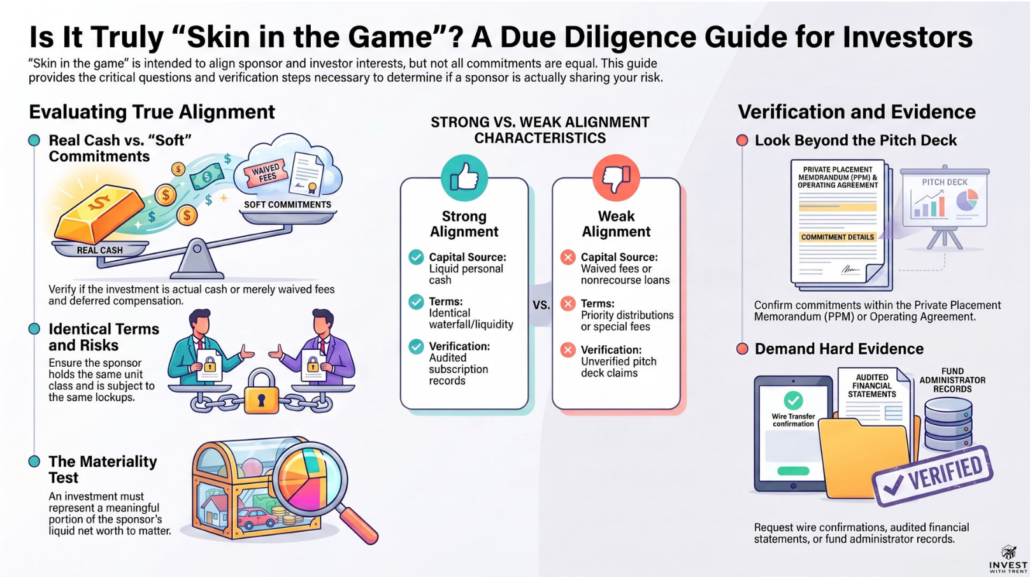
“Skin in the game” generally means the sponsor has invested its own capital alongside investors and can lose that capital if the fund performs poorly.
The idea is alignment: if investors lose money, the sponsor should feel the loss too.
But not every sponsor commitment creates the same alignment.
Suppose a sponsor claims to have invested $1 million. You still need to ask:
1. Is it actual cash?
A waived management fee, deferred compensation or the value of the sponsor’s time may be described as an investment. Those things have value, but they are not the same as wiring $1 million of the sponsor’s own money into the fund.
2. Whose money is it?
Was the capital contributed personally by the principals? Did it come from the management company? Was it borrowed—or financed by the fund itself?
Borrowed capital may still be at risk, but the loan terms matter. A “commitment” funded through a favorable, nonrecourse loan does not create the same alignment as cash earned elsewhere and invested alongside you.
3. Is it invested on the same terms?
Does the sponsor own the same class of units as investors? Is its capital subject to the same losses, lockup and distribution waterfall?
If the sponsor gets its money back first, earns special fees or has greater liquidity, you are not taking identical risks.
4. Is the investment meaningful to the sponsor?
A $500,000 commitment sounds substantial. But it means something different to a sponsor worth $5 million than to one worth $500 million.
You do not need the sponsor’s personal financial statement, but it is reasonable to ask whether the investment represents a meaningful amount of the principals’ liquid net worth.
5. Can you verify it?
Look for the sponsor commitment in the private placement memorandum, operating agreement or limited partnership agreement. Then ask for evidence that the capital was actually funded, such as:
✅ Audited financial statements
✅ A capital-account statement
✅ Subscription records
✅ Confirmation from the fund administrator
✅ Proof of the sponsor’s wire, with sensitive information redacted
Also ask whether the sponsor has already received any of that capital back through fees, reimbursements or distributions.
Skin in the game is valuable, but it is not a substitute for competent underwriting, conservative leverage or proper controls. A sponsor can lose money alongside you—and still make a terrible investment.
The strongest alignment is not simply, “We invested too.”
It is: “We invested meaningful cash, on substantially the same terms, behind the same collateral—and here are the documents that prove it.”
Want to learn more about how investing in my real estate private credit fund can yield approximately 10% with monthly income? Follow me here.