Most investors begin due diligence on a private debt fund with one question:
“What’s the return?”
That matters. But it’s not where I would start.
A 12% yield tells you what the manager hopes to pay you. It does not tell you how much risk they are taking to produce it.
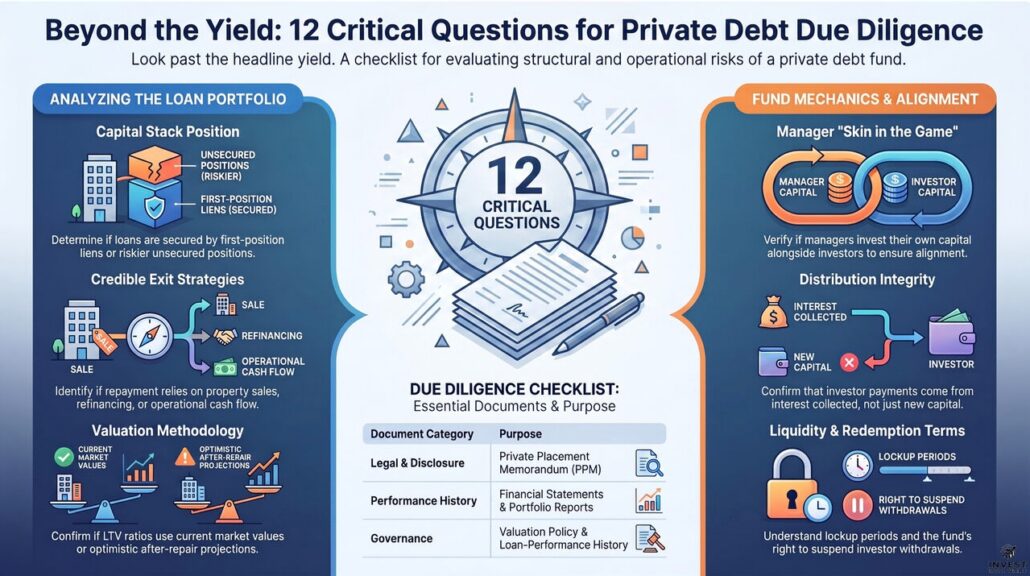
Before investing, I would ask these questions:
1. What exactly will the fund lend against?
Asset type, geography, loan purpose and borrower profile all matter. “Real estate-backed” is far too broad.
2. Where does the fund sit in the capital stack?
Are the loans secured by first-position liens? Can the fund make second-lien or unsecured loans? What debt could be senior to you?
3. What is the maximum loan-to-value?
More importantly: how is the property value determined? Ask whether LTV is based on today’s value, purchase price or an optimistic after-repair value.
4. Who performs the underwriting?
You want to understand the manager’s process for evaluating the borrower, collateral, repayment plan and downside—not just the opportunity.
5. How does each borrower repay the loan?
Every loan needs a credible exit. Is repayment expected from a sale, refinance, construction completion or operating cash flow? Then ask what happens if that exit is delayed.
6. What happens when a borrower stops paying?
Ask for actual examples. How many loans have gone delinquent? How many were modified, foreclosed on or resulted in a loss? How long did recovery take?
A manager who says, “We’ve never had a problem,” may be inexperienced—or redefining “problem.”
7. How concentrated can the portfolio become?
What percentage of the fund can be exposed to one borrower, property, market or strategy? One bad loan should not be able to sink the entire fund.
8. Does the fund use leverage?
Borrowing can increase investor returns, but it can also magnify losses and create liquidity pressure. Ask how much leverage is permitted, what it costs and whether the lender can force asset sales.
9. Are distributions earned or supported by investor capital?
A distribution is not automatically profit. Ask whether payments come entirely from interest collected from borrowers.
10. What fees do I pay?
Look beyond the management fee. Ask about origination fees, extension fees, servicing fees, exit fees and whether they go to the fund or the manager.
11. How much of the manager’s own money is invested?
Skin in the game does not eliminate risk, but alignment matters. I want the manager experiencing losses alongside investors—not simply losing future fee income.
12. When can I get my money back?
Understand the lockup, redemption limits, notice requirements and the fund’s right to suspend withdrawals. Private debt is not a savings account.
Finally, ask for the documents that verify the answers: the private placement memorandum, financial statements, portfolio reports, valuation policy and loan-performance history.
The goal is not to find a fund with no risk. That fund does not exist.