Loan-to-value, or LTV, measures the size of a loan compared with the value of the property securing it.
The formula is simple:
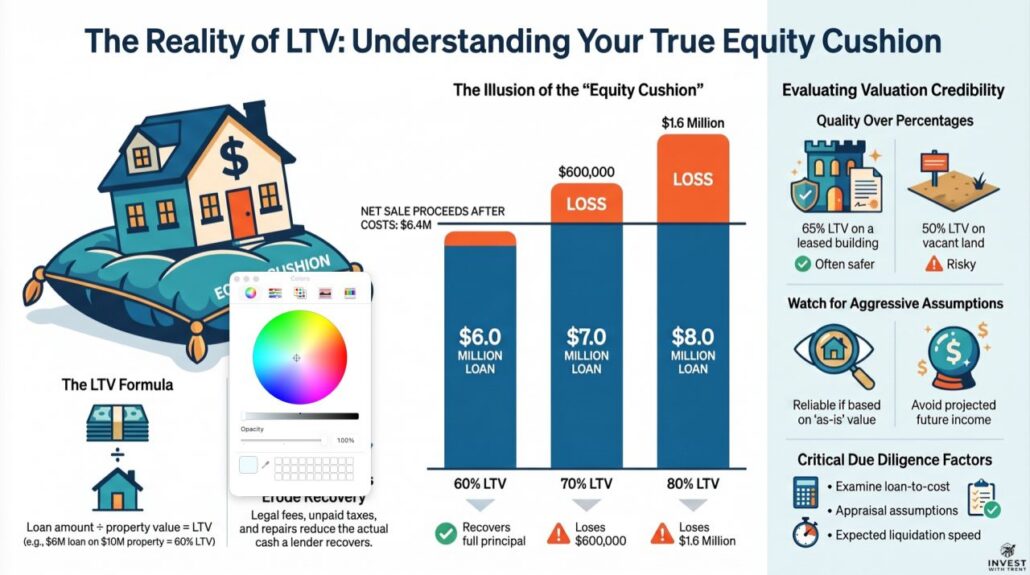
Loan amount ÷ property value = LTV
If a lender makes a $6 million loan against a property valued at $10 million, the LTV is 60%.
That means the borrower has $4 million of equity beneath the lender.
In theory, the property could fall 40% in value before the lender begins losing principal.
But that is not how it works in practice.
Foreclosure costs money. Legal fees, unpaid taxes, insurance, repairs, property management, commissions and months of missed interest all reduce what the lender ultimately recovers.
So a 60% LTV does not provide a full 40% cushion.
Suppose the $10 million property falls in value and eventually sells for $7 million.
After $600,000 of workout and selling costs, the lender receives $6.4 million.
A $6 million loan is still protected—but barely.
Now compare three loans on the same $10 million property:
– 60% LTV: $6 million loan
– 70% LTV: $7 million loan
– 80% LTV: $8 million loan
If net sale proceeds fall to $6.4 million:
– The 60% lender recovers its principal
– The 70% lender loses $600,000
– The 80% lender loses $1.6 million
That is why lower LTV generally means greater protection.
But what LTV is actually safe?
There is no universal number.
A 65% LTV loan against a fully leased apartment building in a liquid market may be safer than a 50% LTV loan against vacant land, an unfinished development or a property valued using aggressive assumptions.
The number only matters if the valuation is credible.
Sophisticated lenders ask:
Value based on what?
– Current condition or completed condition?
– Current income or projected income?
– A recent purchase price or an appraisal?
– Stable occupancy or future lease-up assumptions?
– Today’s cap rate or the cap rate the borrower hopes to achieve?
A lender can claim a conservative 60% LTV while actually lending 85% of the property’s realistic liquidation value.
That is why investors should look beyond headline LTV and examine:
– Loan-to-cost
– Current “as-is” value
– Stabilized or future value
– Borrower cash equity
– Appraisal assumptions
– Expected foreclosure costs
– How quickly the property could actually be sold
As a broad principle, first-position loans below roughly 65% LTV provide a more meaningful equity cushion than loans made at 75%–80%.
But LTV is not a guarantee.
A low LTV protects the investor only when the value is real, the lien is enforceable and the property can be sold without the recovery being consumed by time and costs.