“Hard money” sounds like a loan for someone in financial trouble.
Sometimes it is.
But in commercial real estate, it often means something much simpler:
Short-term financing secured primarily by the property—not by the borrower’s current income.
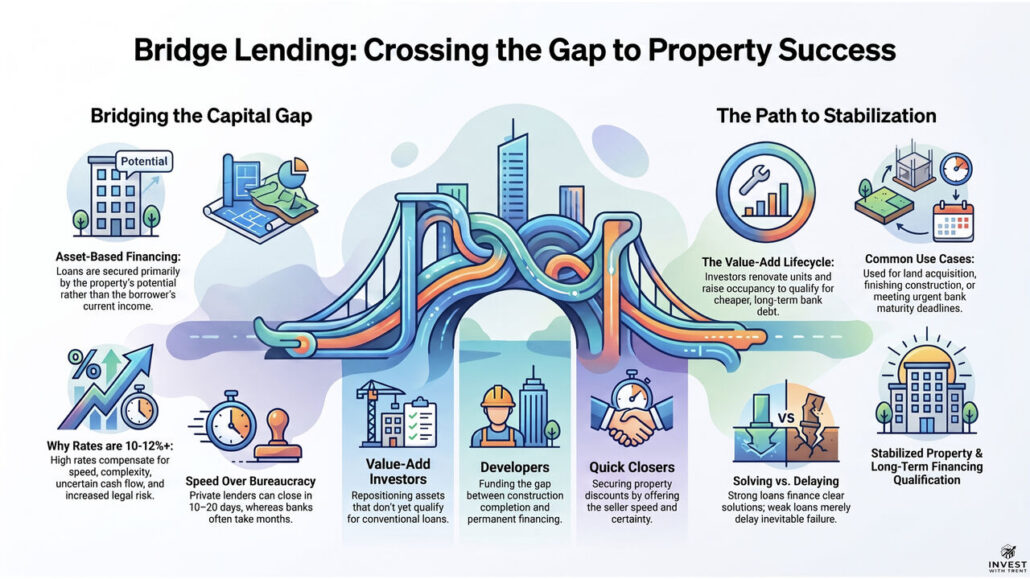
A bridge loan does exactly what the name suggests. It helps a borrower cross the gap between where a property is today and where it needs to be before cheaper, long-term financing becomes available.
For example, an investor buys an apartment building that is only 60% occupied.
A bank may decline the loan because the property does not yet produce enough income.
A bridge lender may fund the acquisition and renovations. The borrower then improves the units, raises occupancy, stabilizes the cash flow and refinances with a bank.
The bridge loan was never intended to be permanent.
So who actually borrows at rates of 10%, 12% or more?
1. Value-add real estate investors
They buy properties needing renovation, new management, lease-up or repositioning. The asset does not qualify for conventional financing yet.
2. Developers
Construction schedules do not always line up neatly with bank requirements. A bridge loan may fund land acquisition, completion costs or the period between construction and permanent financing.
3. Investors who need to close quickly
A seller may offer a discount in exchange for certainty and speed. A private lender might close in 10–20 days while a bank could take months.
4. Owners facing a maturity deadline
A bank loan may be coming due before the property is ready to refinance. Short-term capital can prevent a forced sale while the owner completes the business plan.
5. Borrowers with complicated situations
The property may be vacant, partially completed, poorly documented, in foreclosure, tied up in an estate or affected by a temporary credit issue.
That does not automatically make it a bad loan. It does make the underwriting more important.
Why are the rates so high?
Because the lender is being paid for more than the use of money.
The rate compensates for speed, complexity, shorter duration, uncertain cash flow, legal risk and the possibility that the lender may need to take control of the property.
But there is an important distinction:
Some borrowers use bridge debt to create value. Others use it to delay failure.
A strong bridge loan has a believable exit:
– Complete the renovation
– Increase occupancy
– Sell the property
– Refinance with a bank
A weak loan depends on property values rising, rates falling or another lender appearing before the money runs out.
That is the real question for investors:
Is the loan financing a temporary problem with a clear solution—or a permanent problem with a temporary loan?