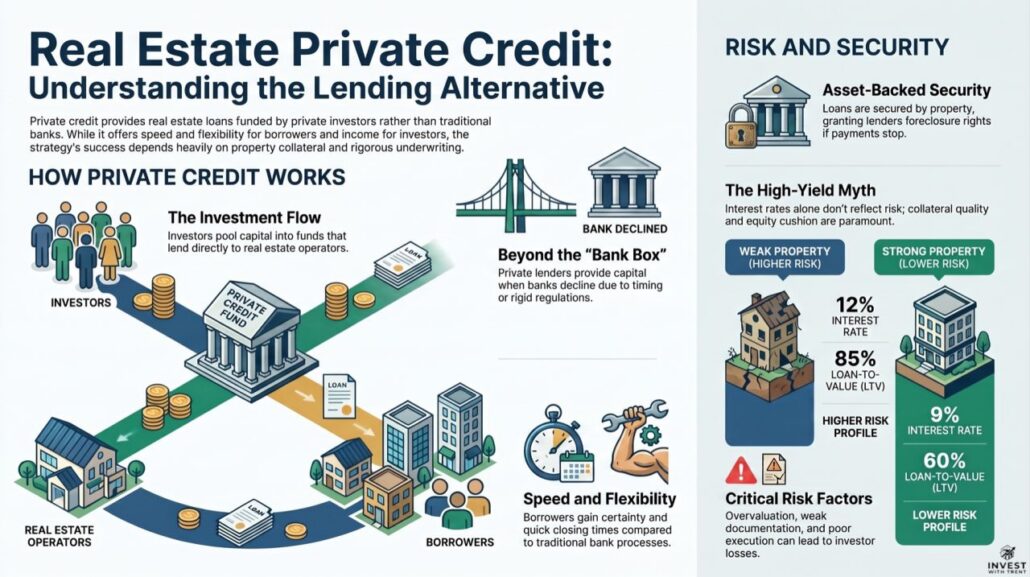
Private credit is simply a loan that is made by investors instead of a traditional bank.
Imagine a real estate operator wants to buy or refinance a $10 million apartment building.
A bank might decline the loan because:
• The property needs renovations
• The borrower needs to close quickly
• The deal doesn’t fit the bank’s lending rules
• The bank is reducing its exposure to commercial real estate
That doesn’t necessarily mean it’s a bad deal. It may simply mean the loan doesn’t fit inside the bank’s box.
So the borrower turns to a private credit fund.
The fund collects money from investors, lends it to the borrower, and earns interest and fees in return. After expenses, most of that income is distributed to the fund’s investors.
That is private credit.
The borrower gets speed, flexibility, and certainty.
The investor gets access to income generated by loans that are not traded on the public stock market.
In real estate, those loans are typically secured by the property. If the borrower stops making payments, the lender may have the right to take control of or foreclose on the asset.
That security matters—but it does not eliminate risk.
Private credit investors can still lose money if:
• The property was overvalued
• The borrower cannot execute the business plan
• The lender advanced too much money
• The loan documents are weak
• The property’s value falls below the loan balance
• The fund promises investors more liquidity than the underlying loans provide
This is why the headline interest rate tells you very little by itself.
A 12% loan secured by a weak property at 85% of its value may be far riskier than a 9% loan secured by a strong property at 60% of its value.
The questions that matter are:
1) What secures the loan?
2) How much equity sits beneath it?
3) Who made the loan?
4) What happens if the borrower cannot repay it?
Private credit is not a magical high-yield alternative to bonds.
It is lending.
And the quality of any lending strategy ultimately depends on underwriting, collateral, structure, and what the lender is willing to do when things go wrong.
Want to learn more about investing in real estate private credit? Follow me here.